


Page 442 - (DK Eyewitness) Travel Guide - South Africa
P. 442
440       SUR VIV AL  GUIDE


       Travelling by Car                       compulsory in the front
                                               and in the back. Children must
       Although bus services in South Africa are fast, affordable and   be properly restrained.
       comprehensive, a car provides the greatest flexibility and is     Speed limits are 120 km per
                                               hour (75 mph) on motorways
       the only way to visit the more remote areas. Overall, South
                                               and major roads and 40–80 km
       Africa’s road network is very good, especially those routes
                                               per hour (25–50 mph) in towns
       that are part of the N-prefixed national road system. In rural   and cities. In parks and reserves,
       areas, only main arteries may be tarred, but dirt roads are   the speed limit is not more than
       usually levelled and in good condition. Unfortunately, long   40 km per hour (25 mph).
       distances and other road users constitute the major hazards.     South Africa has strict drink-
                                               driving laws. The legal blood
       Along the major routes there are many service and petrol
                                               alcohol level is 0.05 per cent
       stations, and the main attractions are well signposted.
                                               maximum, which is the
                                               equivalent of one glass of beer
                                               or wine. Anyone caught driving
                                               above this limit is liable for
                                               a hefty fine, or up to six
                                               years’ imprisonment.
                                               Fuel
                                               Motor vehicles run on 97
                                               Octane petrol, unleaded petrol
                                               or diesel fuel, and the unit of
                                               liquid measurement is the litre
                                               (0.22 UK gallons or 0.264 US
                                               gallons). Service sta tion
                                               attendants see to refuelling and
                                               other checks such as tyre
                                               pressure, oil, water, and cleaning
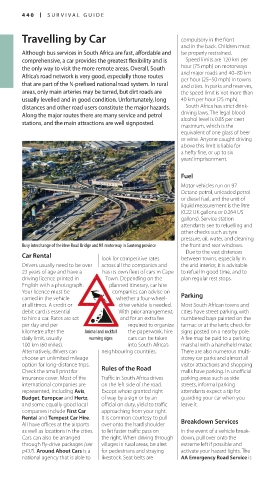
       Busy interchange of the New Road Bridge and N1 motorway in Gauteng province  the front and rear windows.
                                                 Due to the vast distances
       Car Rental
                           look for competitive rates   between towns, especially in
       Drivers usually need to be over   across all the companies and   the arid interior, it is advisable
       23 years of age and have a   has its own fleet of cars in Cape   to refuel in good time, and to
       driving licence printed in   Town. Depending on the   plan regular rest stops.
       English with a photograph.   planned itinerary, car hire
       Your licence must be   companies can advise on
       carried in the vehicle   whether a four-wheel-  Parking
       at all times. A credit or   drive vehicle is needed.   Most South African towns and
       debit card is essential   With prior arrangement,   cities have street parking, with
       to hire a car. Rates are set   and for an extra fee   number ed bays painted on the
       per day and per            required to organize   tarmac or at the kerb; check for
       kilometre after the   Animal and rockfall   the paperwork, hire   signs posted on a nearby pole.
       daily limit, usually    warning signs  cars can be taken   A fee may be paid to a parking
       100 km (60 miles).         into South Africa’s   marshal with a handheld meter.
       Alternatively, drivers can   neighbouring countries.  There are also numerous multi-
       choose an unlimited mileage             storey car parks and almost all
       option for long-distance trips.         visitor attractions and shopping
       Check the small print for   Rules of the Road  malls have parking. In unofficial
       insurance cover. Most of the   Traffic in South Africa drives    parking areas such as side
       international companies are   on the left side of the road.   streets, informal parking
       represented, including Avis,   Except where granted right    attendants expect a tip for
       Budget, Europcar and Hertz,   of way by a sign or by an    guarding your car when you
       and some equally good local   official on duty, yield to traffic   leave it.
       companies include First Car   approaching from your right.
       Rental and Tempest Car Hire.   It is common courtesy to pull
       All have offices at the airports   over onto the hard shoulder    Breakdown Services
       as well as locations in the cities.   to let faster traffic pass on    In the event of a vehicle break-
       Cars can also be arranged   the right. When driving through   down, pull over onto the
       through fly-drive packages (see   villages in rural areas, be alert   extreme left if possible and
       p437). Around About Cars is a   for pedestrians and straying   activate your hazard lights. The
       national agency that is able to   livestock. Seat belts are   AA Emergency Road Service is

