


Page 68 - World of Animals - Issue #39
P. 68
Saving orangutans

            Gardeners of the forest


            Take a trip into the treetops and discover
            the amazing life history of the orangutan

            Orangutans generally live alone but females can be seen with
            their adorable babies clinging on as they swing through the
            trees. The apes make lofty nests from leaves and branches and
            sleep in the trees to avoid predators. Although not many are
            large enough to take on a 90 kilogram (200 pound) ape, that’s
            not to say that hungry big cats won't try.
              Dominant male orangutans also live alone and keep loose

            territory boundaries. These big boys have large, fleshy pouches

            either side of their faces known as ‘flanges’ – but curiously

            only some males develop this. Mature yet ‘un-flanged’ males
            can develop into ‘flanged’ males too, but we still don’t know

            exactly why or how!
              Like the rest of their great ape cousins, these apes are
            a clever and sensitive species, and social learning plays
            a key part in orangutan education. Babies observe their
            parents using tools, and adopt this for themselves. Ingenious
            orangutans have been witnessed using sticks to rake food, dip
            in honey, remove seeds from fruit, spear fish in the water and

            test water depth. Some even use leaves as umbrellas, as cups
            to drink water and as instruments to amplify their vocal
            calls to warn off predators!
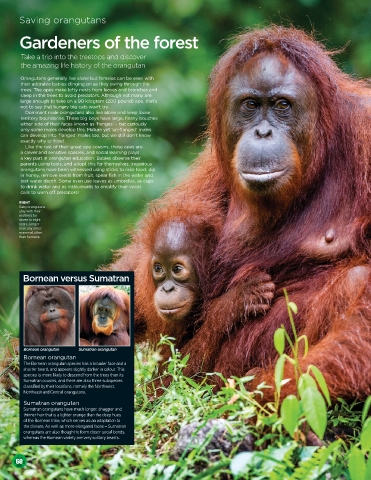
            RIGHT
            Baby orangutans
            stay with their
            mothers for
            seven to eight
            years, longer
            than any other
            mammal other
            than humans


             Bornean versus Sumatran


              Bornean orangutan  Sumatran orangutan
              Bornean orangutan
              The Bornean orangutan species has a broader face and a
              shorter beard, and appears slightly darker in colour. This
              species is more likely to descend from the trees than its
              Sumatran cousins, and there are also three subspecies

              classified by their locations, namely the Northwest,
              Northeast and Central orangutans.
              Sumatran orangutan
              Sumatran orangutans have much longer, shaggier and
              thinner hair that is a lighter orange than the deep hues
              of the Bornean tribe, which serves as an adaptation to
              the climate. As well as more elongated faces – Sumatran
              orangutans are also thought to form closer social bonds,
              whereas the Bornean variety are very solitary beasts.


           68


       066-070_Conserving Orangutans.indd   68                                                                               12/10/2016   17:16

