


Page 39 - All About History - Issue 27-15
P. 39
Bluffer’s Guide
UK MINERS’ STRIKE
What was it?
The UK miners’ strike was a year-long national strike
undertaken by the National Union of Mineworkers
(NUM). It began on 6 March with miners in the
Yorkshire coal field, and on 12 March the NUM president
Arthur Scargill called for strike action in all coal fields.
Initially, almost all miners in Yorkshire, Scotland, the
north east and Kent observed the strike, but miners in the
Midlands and North Wales – those least threatened by the
pit closures – were more reluctant to join.
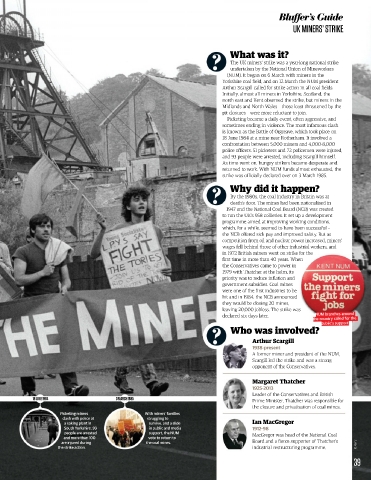
Picketing became a daily event, often aggressive, and
sometimes ending in violence. The most infamous clash
is known as the Battle of Orgreave, which took place on
18 June 1984 at a mine near Rotherham. It involved a
confrontation between 5,000 miners and 4,000-8,000
police officers. 51 picketers and 72 policemen were injured,
and 93 people were arrested, including Scargill himself.
As time went on, hungry strikers became desperate and
returned to work. With NUM funds almost exhausted, the
strike was officially declared over on 3 March 1985.
Why did it happen?
By the 1980s, the coal industry in Britain was at
death’s door. The mines had been nationalised in
1947 and the National Coal Board (NCB) was created
to run the UK’s 958 collieries. It set up a development
programme aimed at improving working conditions,
which, for a while, seemed to have been successful –
the NCB offered sick pay and improved safety. But as
competition from oil and nuclear power increased, miners’
wages fell behind those of other industrial workers, and
in 1972 British miners went on strike for the
first time in more than 40 years. Whe
the Conservatives came to power in
1979 with Thatcher at the helm, its
priority was to reduce inflation and
government subsidies. Coal mines
were one of the first industries to be
hit and in 1984, the NCB announced
theywouldbeclosing20mines,
leaving20,000jobless.Thestrikewa
declaredsixdayslater. NUM branches around
the country called for the
public’s support
Who was involved?
Arthur Scargill
1938-present
A former miner and president of the NUM,
Scargill led the strike and was a strong
opponent of the Conservatives.
Margaret Thatcher
1925-2013
Leader of the Conservatives and British
18 JUNE 1984 3 MARCH 1985
Prime Minister, Thatcher was responsible for
the closure and privatisation of coal mines.
Picketing miners With miners’ families
clash with police at struggling to
a coking plant in survive, and a slide Ian MacGregor
South Yorkshire. 93 in public and media 1912-98
people are arrested support, the NUM MacGregor was head of the National Coal
and more than 100 vote to return to
are injured during the coal mines. Board and a fierce supporter of Thatcher’s © Alamy
the strike action. industrial restructuring programme.
39

