


Page 87 - Just Enough English Grammar Illustrated Book
P. 87
The term present participle refers to an action in the present.
           As we move to the next principal part, you will find that the
           word past in the term past participle indicates an action that
           already took place. Keep this distinction in mind when we cover
           verb tenses.

           4.9  The Fourth Principal Part: Past Participle 4

                                     Base form: walk
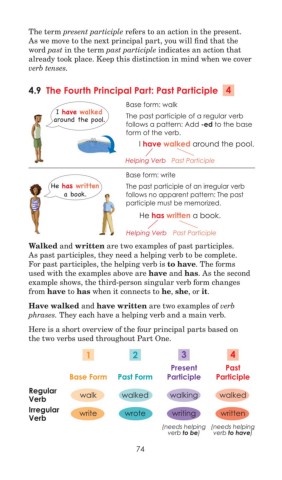
                  I have walked
                  around the pool.   The past participle of a regular verb
                                     follows a pattern: Add -ed to the base
                                     form of the verb.
                                        I have walked around the pool.

                                     Helping Verb Past Participle
                                     Base form: write
                 He has written      The past participle of an irregular verb
                     a book.         follows no apparent pattern: The past
                                     participle must be memorized.
                                         He has written a book.

                                     Helping Verb Past Participle
           Walked and written are two examples of past participles.
           As past participles, they need a helping verb to be complete.
           For past participles, the helping verb is to have. The forms
           used with the examples above are have and has. As the second
           example shows, the third-person singular verb form changes
           from have to has when it connects to he, she, or it.
           Have walked and have written are two examples of verb
           phrases. They each have a helping verb and a main verb.

           Here is a short overview of the four principal parts based on
           the two verbs used throughout Part One.


                                                 Present       Past
                      Base Form    Past Form    Participle   Participle
           Regular
           Verb          walk       walked       walking      walked
           Irregular     write       wrote       writing      written
           Verb
                                               (needs helping (needs helping
                                                verb to be)  verb to have)
                                        74

