


Page 20 - BBC Music (January 2020)
P. 20
The full score


                                                             THE LISTENING SERVICE


                                        The art of Rossini


                             Rossini’s ebullient comic
                             operas and catchy tunes
                             have distracted us from his
                             music’s considerable artistry
                             and heartfelt humanity,
                             laments Tom Service


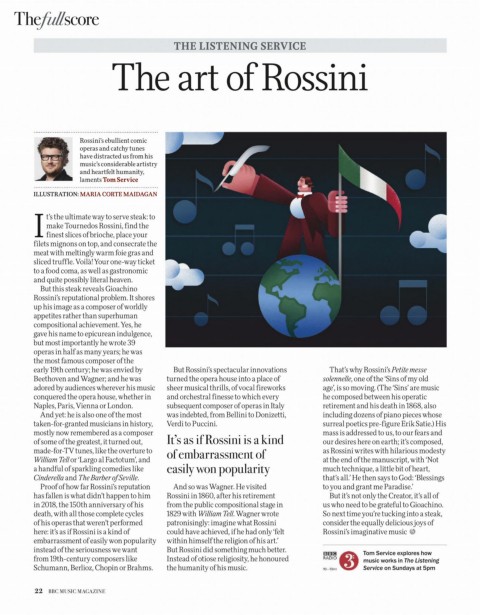
             ILLUSTRATION: MARIA CORTE MAIDAGAN


                 t’s the ultimate way to serve steak: to
                 make Tournedos Rossini, find the
             I finest slices of brioche, place your
             filets mignons on top, and consecrate the
             meat with meltingly warm foie gras and
             sliced truffle. Voilà! Your one-way ticket
             to a food coma, as well as gastronomic
             and quite possibly literal heaven.
               But this steak reveals Gioachino
             Rossini’s reputational problem. It shores
             up his image as a composer of worldly
             appetites rather than superhuman
             compositional achievement. Yes, he
             gave his name to epicurean indulgence,
             but most importantly he wrote 39
             operas in half as many years; he was
             the most famous composer of the
             early 19th century; he was envied by            But Rossini’s spectacular innovations                  That’s why Rossini’s Petite messe
             Beethoven and Wagner; and he was              turned the opera house into a place of                solennelle, one of the ‘Sins of my old
             adored by audiences wherever his music        sheer musical thrills, of vocal fireworks             age’, is so moving. (The ‘Sins’ are music
             conquered the opera house, whether in         and orchestral finesse to which every                 he composed between his operatic
             Naples, Paris, Vienna or London.              subsequent composer of operas in Italy                retirement and his death in 1868, also
               And yet: he is also one of the most         was indebted, from Bellini to Donizetti,              including dozens of piano pieces whose
             taken-for-granted musicians in history,       Verdi to Puccini.                                     surreal poetics pre-figure Erik Satie.) His
             mostly now remembered as a composer                                                                 mass is addressed to us, to our fears and
             of some of the greatest, it turned out,       It’s as if Rossini is a kind                          our desires here on earth; it’s composed,
             made-for-TV tunes, like the overture to       of embarrassment of                                   as Rossini writes with hilarious modesty
             William Tell or ‘Largo al Factotum’, and                                                            at the end of the manuscript, with ‘Not
             a handful of sparkling comedies like          easily won popularity                                 much technique, a little bit of heart,
             Cinderella and The Barber of Seville.                                                               that’s all.’ He then says to God: ‘Blessings
               Proof of how far Rossini’s reputation         And so was Wagner. He visited                       to you and grant me Paradise.’
             has fallen is what didn’t happen to him       Rossini in 1860, after his retirement                    But it’s not only the Creator, it’s all of
             in 2018, the 150th anniversary of his         from the public compositional stage in                us who need to be grateful to Gioachino.
             death, with all those complete cycles         1829 with William Tell. Wagner wrote                  So next time you’re tucking into a steak,
             of his operas that weren’t performed          patronisingly: imagine what Rossini                   consider the equally delicious joys of
             here: it’s as if Rossini is a kind of         could have achieved, if he had only ‘felt             Rossini’s imaginative music
             embarrassment of easily won popularity        within himself the religion of his art.’
             instead of the seriousness we want            But Rossini did something much better.
                                                                                                                               Tom Service explores how
             from 19th-century composers like              Instead of otiose religiosity, he honoured                          music works in The Listening
             Schumann, Berlioz, Chopin or Brahms.          the humanity of his music.                                          Service on Sundays at 5pm


             22   BBC MUSIC MAGAZINE

