


Page 55 - BBC Music (January 2020)
P. 55
COMPOSER OF THE MONTH


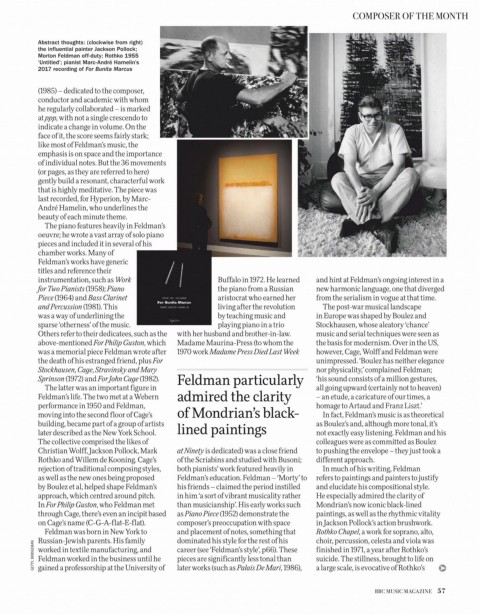
              Abstract thoughts: (clockwise from right)
              the influential painter Jackson Pollock;
              Morton Feldman off-duty; Rothko 1955
              ‘Untitled’; pianist Marc-André Hamelin’s
              2017 recording of For Bunita Marcus


              (1985) – dedicated to the composer,
              conductor and academic with whom
              he regularly collaborated – is marked
              at ppp, with not a single crescendo to
              indicate a change in volume. On the
              face of it, the score seems fairly stark;
              like most of Feldman’s music, the
              emphasis is on space and the importance
              of individual notes. But the 36 movements
              (or pages, as they are referred to here)
              gently build a resonant, characterful work
              that is highly meditative. The piece was
              last recorded, for Hyperion, by Marc-
              André Hamelin, who underlines the
              beauty of each minute theme.
                The piano features heavily in Feldman’s
              oeuvre; he wrote a vast array of solo piano
              pieces and included it in several of his
              chamber works. Many of
              Feldman’s works have generic
              titles and reference their
              instrumentation, such as Work                                  Buffalo in 1972. He learned       and hint at Feldman’s ongoing interest in a
              for Two Pianists (1958); Piano                                 the piano from a Russian          new harmonic language, one that diverged
              Piece (1964) and Bass Clarinet                                 aristocrat who earned her         from the serialism in vogue at that time.
              and Percussion (1981). This                                    living after the revolution         The post-war musical landscape
              was a way of underlining the                                   by teaching music and             in Europe was shaped by Boulez and
              sparse ‘otherness’ of the music.                               playing piano in a trio           Stockhausen, whose aleatory ‘chance’
              Others refer to their dedicatees, such as the    with her husband and brother-in-law.            music and serial techniques were seen as
              above-mentioned For Philip Guston, which         Madame Maurina-Press (to whom the               the basis for modernism. Over in the US,
              was a memorial piece Feldman wrote after         1970 work Madame Press Died Last Week           however, Cage, Wolff and Feldman were
              the death of his estranged friend, plus For                                                      unimpressed. ‘Boulez has neither elegance
              Stockhausen, Cage, Stravinsky and Mary                                                           nor physicality,’ complained Feldman;
              Sprinson (1972) and For John Cage (1982).        Feldman particularly                            ‘his sound consists of a million gestures,
                The latter was an important figure in                                                          all going upward (certainly not to heaven)
              Feldman’s life. The two met at a Webern          admired the clarity                             – an etude, a caricature of our times, a
              performance in 1950 and Feldman,                                                                 homage to Artaud and Franz Liszt.’
              moving into the second floor of Cage’s           of Mondrian’s black-                              In fact, Feldman’s music is as theoretical
              building, became part of a group of artists                                                      as Boulez’s and, although more tonal, it’s
              later described as the New York School.          lined paintings                                 not exactly easy listening. Feldman and his
              The collective comprised the likes of                                                            colleagues were as committed as Boulez
              Christian Wolff, Jackson Pollock, Mark           at Ninety is dedicated) was a close friend      to pushing the envelope – they just took a
              Rothko and Willem de Kooning. Cage’s             of the Scriabins and studied with Busoni;       different approach.
              rejection of traditional composing styles,       both pianists’ work featured heavily in           In much of his writing, Feldman
              as well as the new ones being proposed           Feldman’s education. Feldman – ‘Morty’ to  refers to paintings and painters to justify
              by Boulez et al, helped shape Feldman’s          his friends – claimed the period instilled      and elucidate his compositional style.
              approach, which centred around pitch.            in him ‘a sort of vibrant musicality rather     He especially admired the clarity of
              In For Philip Guston, who Feldman met            than musicianship’. His early works such        Mondrian’s now iconic black-lined
              through Cage, there’s even an incipit based      as Piano Piece (1952) demonstrate the           paintings, as well as the rhythmic vitality
              on Cage’s name (C-G-A-flat-E-flat).              composer’s preoccupation with space             in Jackson Pollock’s action brushwork.
                Feldman was born in New York to                and placement of notes, something that          Rothko Chapel, a work for soprano, alto,
                                                                                                               choir, percussion, celesta and viola was
                                                               dominated his style for the rest of his
              Russian-Jewish parents. His family
             GETTY, BRIDGEMAN  worked in textile manufacturing, and   career (see ‘Feldman’s style’, p66). These   finished in 1971, a year after Rothko’s
                                                                                                               suicide. The stillness, brought to life on
              Feldman worked in the business until he
                                                               pieces are significantly less tonal than
                                                                                                               a large scale, is evocative of Rothko’s
                                                               later works (such as Palais De Mari, 1986),
              gained a professorship at the University of
                                                                                                                                    BBC MUSIC MAGAZINE   57

