


Page 69 - BBC Music (January 2020)
P. 69
Orchestral Reviews


              Beethoven
              Symphonies Nos 5 & 6
              WDR Symphony Orchestra/
              Marek Janowski
              Pentatone PTC 5186 809   73:04 mins
                               In music of this
                               time-honoured
                               humanity and
                               greatness, there
                               are bound to
                               be aspects
              that almost any given line-up
              of performers will respond to.
              Here we have a German radio
              orchestra which, while not in
              the absolute top-flight Berlin or
              Viennese league, is (merely!) very
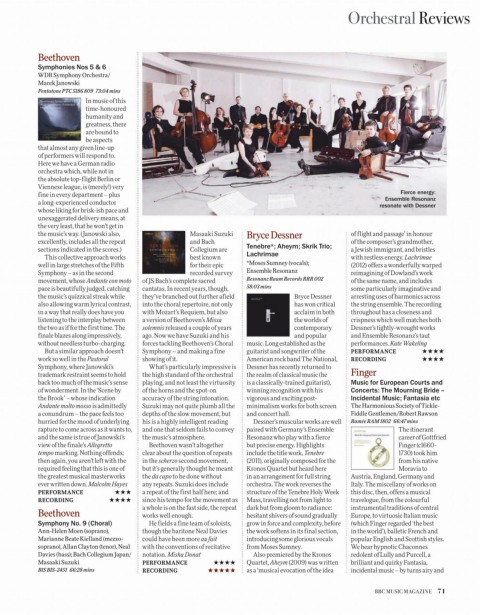
              fine in every department – plus                                                                                               Fierce energy:
                                                                                                                                       Ensemble Resonanz
              a long-experienced conductor
                                                                                                                                     resonate with Dessner
              whose liking for brisk-ish pace and
              unexaggerated delivery means, at
              the very least, that he won’t get in
              the music’s way. (Janowski also,                     Masaaki Suzuki      Bryce Dessner                       of flight and passage’ in honour
              excellently, includes all the repeat                 and Bach                                                of the composer’s grandmother,
              sections indicated in the scores.)                   Collegium are       Tenebre*; Aheym; Skrik Trio;        a Jewish immigrant, and bristles
                This collective approach works                     best known          Lachrimae                           with restless energy. Lachrimae
              well in large stretches of the Fifth                 for their epic      *Moses Sumney (vocals);             (2012) offers a wonderfully warped
              Symphony – as in the second                          recorded survey     Ensemble Resonanz                   reimagining of Dowland’s work
              movement, whose Andante con moto    of JS Bach’s complete sacred         Resonanz Raum Records RRR 002       of the same name, and includes
              pace is beautifully judged, catching   cantatas. In recent years, though,   58:03 mins                       some particularly imaginative and
              the music’s quizzical streak while   they’ve branched out further afield                 Bryce Dessner       arresting uses of harmonics across
              also allowing warm lyrical contrast,   into the choral repertoire, not only              has won critical    the string ensemble. The recording
              in a way that really does have you   with Mozart’s Requiem, but also                     acclaim in both     throughout has a closeness and
              listening to the interplay between   a version of Beethoven’s Missa                      the worlds of       crispness which well matches both
              the two as if for the first time. The   solemnis released a couple of years              contemporary        Dessner’s tightly-wrought works
              finale blazes along impressively,   ago. Now we have Suzuki and his                      and popular         and Ensemble Resonanz’s taut
              without needless turbo-charging.    forces tackling Beethoven’s Choral   music. Long established as the      performances. Kate Wakeling
                But a similar approach doesn’t    Symphony – and making a fine         guitarist and songwriter of the     PERFORMANCE              HHHH
              work so well in the Pastoral        showing of it.                       American rock band The National,    RECORDING                HHHH
              Symphony, where Janowski’s             What’s particularly impressive is   Dessner has recently returned to
              trademark restraint seems to hold   the high standard of the orchestral   the realm of classical music (he   Finger
              back too much of the music’s sense   playing, and not least the virtuosity   is a classically-trained guitarist),   Music for European Courts and
              of wonderment. In the ‘Scene by     of the horns and the spot-on         winning recognition with his        Concerts: The Mourning Bride –
              the Brook’ – whose indication       accuracy of the string intonation.   vigorous and exciting post-         Incidental Music; Fantasia etc
              Andante molto mosso is admittedly   Suzuki may not quite plumb all the   minimalism works for both screen    The Harmonious Society of Tickle-
              a conundrum – the pace feels too    depths of the slow movement, but     and concert hall.                   Fiddle Gentlemen/Robert Rawson
              hurried for the mood of underlying   his is a highly intelligent reading   Dessner’s muscular works are well   Ramée RAM 1802   66:47 mins
              rapture to come across as it wants to,   and one that seldom fails to convey   paired with Germany’s Ensemble                 The itinerant
              and the same is true of Janowski’s   the music’s atmosphere.             Resonanz who play with a fierce                      career of Gottfried
              view of the finale’s Allegretto        Beethoven wasn’t altogether       but precise energy. Highlights                       Finger (c1660-
              tempo marking. Nothing offends;     clear about the question of repeats   include the title work, Tenebre                     1730) took him
              then again, you aren’t left with the   in the scherzo second movement,   (2011), originally composed for the                  from his native
              required feeling that this is one of   but it’s generally thought he meant   Kronos Quartet but heard here                    Moravia to
              the greatest musical masterworks    the da capo to be done without       in an arrangement for full string   Austria, England, Germany and
              ever written down. Malcolm Hayes    any repeats. Suzuki does include     orchestra. The work reverses the    Italy. The miscellany of works on
              PERFORMANCE                HHH      a repeat of the first half here; and   structure of the Tenebre Holy Week   this disc, then, offers a musical
              RECORDING                HHHH       since his tempo for the movement as   Mass, travelling not from light to   travelogue, from the colourful
                                                  a whole is on the fast side, the repeat   dark but from gloom to radiance:   instrumental traditions of central
              Beethoven                           works well enough.                   hesitant shivers of sound gradually   Europe, to virtuosic Italian music
              Symphony No. 9 (Choral)                He fields a fine team of soloists,   grow in force and complexity, before   (which Finger regarded ‘the best
              Ann-Helen Moen (soprano),           though the baritone Neal Davies      the work softens in its final section,   in the world’), balletic French and
              Marianne Beate Kielland (mezzo-     could have been more au fait         introducing some glorious vocals    popular English and Scottish styles.
              soprano), Allan Clayton (tenor), Neal   with the conventions of recitative   from Moses Sumney.              We hear hypnotic Chaconnes
              Davies (bass); Bach Collegium Japan/  notation. Misha Donat                Also premiered by the Kronos      redolent of Lully and Purcell, a
              Masaaki Suzuki                      PERFORMANCE              HHHH        Quartet, Aheym (2009) was written   brilliant and quirky Fantasia,
              BIS BIS-2451   66:28 mins           RECORDING              HHHHH         as a ‘musical evocation of the idea   incidental music – by turns airy and


                                                                                                                                    BBC MUSIC MAGAZINE   71

