


Page 95 - BBC Music (January 2020)
P. 95
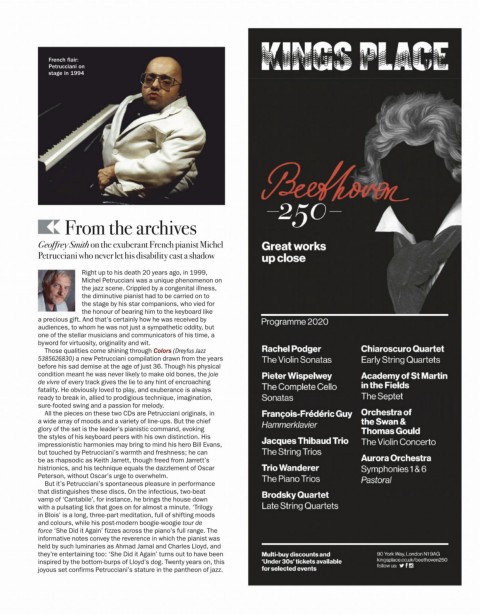
French flair:
                  Petrucciani on
                  stage in 1994


                       From the archives


              Geoffrey Smith on the exuberant French pianist Michel

              Petrucciani who never let his disability cast a shadow


                             Right up to his death 20 years ago, in 1999,
                             Michel Petrucciani was a unique phenomenon on
                             the jazz scene. Crippled by a congenital illness,
                             the diminutive pianist had to be carried on to
                             the stage by his star companions, who vied for
                             the honour of bearing him to the keyboard like
              a precious gift. And that’s certainly how he was received by
              audiences, to whom he was not just a sympathetic oddity, but
              one of the stellar musicians and communicators of his time, a
              byword for virtuosity, originality and wit.
                Those qualities come shining through Colors (Dreyfus Jazz
              5385626830) a new Petrucciani compilation drawn from the years
              before his sad demise at the age of just 36. Though his physical
              condition meant he was never likely to make old bones, the joie
              de vivre of every track gives the lie to any hint of encroaching
              fatality. He obviously loved to play, and exuberance is always
              ready to break in, allied to prodigious technique, imagination,
              sure-footed swing and a passion for melody.
                All the pieces on these two CDs are Petrucciani originals, in
              a wide array of moods and a variety of line-ups. But the chief
              glory of the set is the leader’s pianistic command, evoking
              the styles of his keyboard peers with his own distinction. His
              impressionistic harmonies may bring to mind his hero Bill Evans,
              but touched by Petrucciani’s warmth and freshness; he can
              be as rhapsodic as Keith Jarrett, though freed from Jarrett’s
              histrionics, and his technique equals the dazzlement of Oscar
              Peterson, without Oscar’s urge to overwhelm.
                But it’s Petrucciani’s spontaneous pleasure in performance
              that distinguishes these discs. On the infectious, two-beat
              vamp of ‘Cantabile’, for instance, he brings the house down
              with a pulsating lick that goes on for almost a minute. ‘Trilogy
              in Blois’ is a long, three-part meditation, full of shifting moods
              and colours, while his post-modern boogie-woogie tour de
              force ‘She Did it Again’ fizzes across the piano’s full range. The
              informative notes convey the reverence in which the pianist was
              held by such luminaries as Ahmad Jamal and Charles Lloyd, and
              they’re entertaining too: ‘She Did it Again’ turns out to have been
              inspired by the bottom-burps of Lloyd’s dog. Twenty years on, this
              joyous set confirms Petrucciani’s stature in the pantheon of jazz.

