


Page 44 - (DK Eyewitness) Travel Guide - Sydney
P. 44
42 INTRODUCING SY DNEY
Exploring Sydney’s Architecture
While European settlement in Sydney has a relatively short
history, architectural styles have rapidly evolved from provincial
British buildings and the simplicity of convict structures,
many of which used local sandstone. From the mid-19th
century until the present day, architectural innovations
have borrowed from a range of international trends to
create vernac ular styles more suited to local materials and
conditions. The signs of affluence and austerity, from gold
rush to depression, are also manifested in bricks and mortar.
Australian Regency
Just as the Colonial style was
reaching its zenith, the city’s
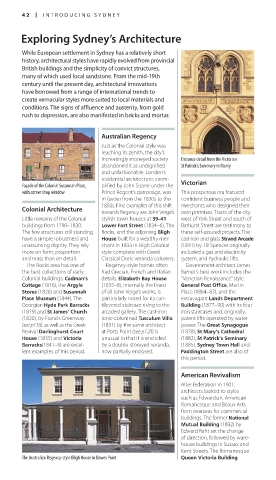
increasingly moneyed society Entrance detail from the Victorian
abandoned it as undignified St Patrick’s Seminary in Manly
and unfashionable. London’s
residential architecture, exem
Façade of the Colonial Susannah Place, plified by John Soane under the Victorian
with corner shop window Prince Regent’s patronage, was This prosperous era featured
in favour from the 1830s to the confident business people and
1850s. Fine examples of this shift merchants who designed their
Colonial Architecture towards Regency are John Verge’s own premises. Tracts of the city
Little remains of the Colonial stylish town houses at 39–41 west of York Street and south of
buildings from 1790–1830. Lower Fort Street (1834–6), The Bathurst Street are testimony to
The few structures still stand ing Rocks, and the adjoining Bligh these selfassured projects. The
have a simple robustness and House built for a wealthy mer castiron and glass Strand Arcade
unassuming dignity. They rely chant in 1833 in High Colonial (1891) by J B Spencer originally
more on form, proportion style complete with Greek included a gas and electricity
and mass than on detail. Classical Doric veranda columns. system, and hydraulic lifts.
The Rocks area has one of Regencystyle homes often Government architect James
the best collections of early had Grecian, French and Italian Barnet’s best work includes the
Colonial buildings: Cadman’s details. Elizabeth Bay House “Venetian Renaissance” style
Cottage (1816), the Argyle (1835–8), internally the finest General Post Office, Martin
Stores (1826) and Susannah of all John Verge’s works, is Place (1864–87), and the
Place Museum (1844). The particularly noted for its can ex travagant Lands Department
Georgian Hyde Park Barracks tilevered staircase rising to the Building (1877–90) with its four
(1819) and St James’ Church arcaded gallery. The castiron iron staircases and, origin ally,
(1820), by Francis Greenway Ioniccolumned Tusculum Villa patent lifts operated by water
(see p116), as well as the Greek (1831) by the same archi tect power. The Great Syna gogue
Revival Darlinghurst Court at Potts Point (see p120) is (1878), St Mary’s Cathedral
House (1835) and Victoria unusual in that it is encircled (1882), St Patrick’s Seminary
Barracks(1841–8) are excel by a doublestoreyed veranda, (1885), Sydney Town Hall and
lent examples of this period. now partially enclosed. Paddington Street are also of
this period.
American Revivalism
After federation in 1901,
architects looked to styles
such as Edwardian, American
Romanesque and Beaux Arts
from overseas for commercial
buildings. The former National
Mutual Building (1892) by
Edward Raht set the change
of direction, followed by ware
house buildings in Sussex and
Kent Streets. The Romanesque
The Australian Regency-style Bligh House in Dawes Point Queen Victoria Building
042-043_EW_Sydney.indd 42 29/05/17 12:15 pm

