


Page 142 - How It Works - Book Of Amazing Answers To Curious Questions, Volume 05-15
P. 142
How does salt

                                                                                     melt ice on the

                                                                                     roads?


                                                                                           e spread granulated salt on icy roads
                                                                                     W because it lowers the freezing and
                                                                                      melting temperature of water. When water
                                                                                      cools to zero degrees Celsius (32 degrees
          Why are bicycles much more                                                  Fahrenheit) or below, it freezes into ice. But
                                                                                      when you add salt, the water must be at a
                                                                                      much lower temperature to freeze. For
          stable when moving?                                                         example, a 20 per cent salt solution would
                                                                                      freeze at -16 degrees Celsius (three degrees
                                                                                      Fahrenheit). If you sprinkle salt on ice that’s

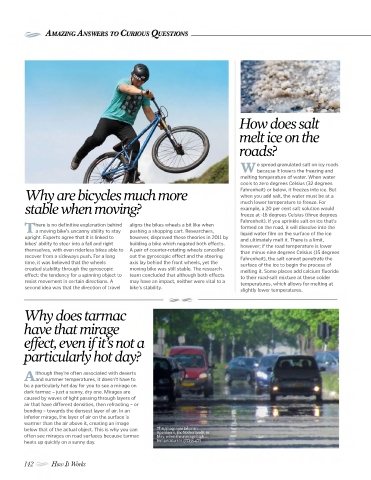
              here is no definitive explanation behind   aligns the bikes wheels a bit like when   formed on the road, it will dissolve into the
          Ta moving bike’s uncanny ability to stay   pushing a shopping cart. Researchers,   liquid water film on the surface of the ice

          upright. Experts agree that it is linked to   however, disproved these theories in 2011 by   and ultimately melt it. There is a limit,
          bikes’ ability to steer into a fall and right   building a bike which negated both effects.   however; if the road temperature is lower
          themselves, with even riderless bikes able to  A pair of counter-rotating wheels cancelled   than minus-nine degrees Celsius (15 degrees
          recover from a sideways push. For a long   out the gyroscopic effect and the steering   Fahrenheit), the salt cannot penetrate the
          time, it was believed that the wheels   axis lay behind the front wheels, yet the   surface of the ice to begin the process of
          created stability through the gyroscopic   moving bike was still stable. The research   melting it. Some places add calcium fl uoride
          effect: the tendency for a spinning object to   team concluded that although both effects   to their road-salt mixture at these colder
          resist movement in certain directions. A   may have an impact, neither were vital to a   temperatures, which allows for melting at
          second idea was that the direction of travel   bike’s stability.
                                                                                      slightly lower temperatures.


         Why does tarmac

         have that mirage

         effect, even if it’s not a

         particularly hot day?


              lthough they’re often associated with deserts
         Aand summer temperatures, it doesn’t have to
          be a particularly hot day for you to see a mirage on
          dark tarmac – just a sunny, dry one. Mirages are
          caused by waves of light passing through layers of
          air that have different densities, then refracting – or
          bending – towards the densest layer of air. In an
          inferior mirage, the layer of air on the surface is
          warmer than the air above it, creating an image
          below that of the actual object. This is why you can   This image was taken in
                                                        Apeldoorn, the Netherlands, in
          often see mirages on road surfaces because tarmac   May, when the average high
          heats up quickly on a sunny day.              temperature is 13°C (55.4°F)


          142       How It Works

