


Page 169 - (DK Eyewitness) Travel Guide 2016 - Austria
P. 169
GR AZ 167
Its narrow façade, exuberantly
decorated with sculptures,
consists of several architectural
planes that create an excep
tionally harmonious composition.
The interior design is the work of
Johann Bernhard Fischer von
Erlach, who was born in Graz and
began his life and career here.
+ Palais Attems
Sackstrasse 17.
Palais Attems is the city’s most
attractive Baroque palace. Built in
1702–16, it was desi gned by
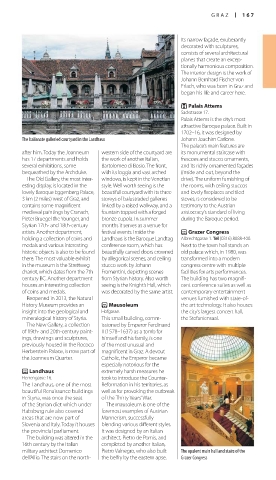
The Italianate galleried courtyard in the Landhaus Johann Joachim Carlone.
The palace’s main features are
after him. Today the Joanneum western side of the courtyard are its monumental staircase with
has 17 departments and holds the work of another Italian, frescoes and stucco ornaments,
several exhibitions, some Bartolomeo di Bosio. The front, and its richly ornamented façades
bequeathed by the Archduke. with its loggia and vast arched (inside and out, beyond the
The Old Gallery, the most inter windows, is kept in the Venetian drive). The uniform furnishing of
esting display, is located in the style. Well worth seeing is the the rooms, with ceiling stuccos
lovely Baroque Eggenberg Palace, beautiful courtyard with its three and lovely fireplaces and tiled
3 km (2 miles) west of Graz, and storeys of balus traded galleries stoves, is considered to be
contains some magnifi cent linked by a raised walkway, and a testimony to the Austrian
medieval paintings by Cranach, fountain topped with a forged aristocracy’s standard of living
Pieter Bruegel the Younger, and bronze cupola. In summer during the Baroque period.
Styrian 17th and 18thcentury months it serves as a venue for
artists. Another department, festival events. Inside the P Grazer Congress
holding a collection of coins and Landhaus is the Baroque Landtag Albrechtgasse 1. Tel (0316) 8088400.
medals and various interesting conference room, which has Next to the town hall stands an
historic objects is also to be found beautifully carved doors crowned old palace which, in 1980, was
there. The most valuable exhibit by allegorical scenes, and ceiling transformed into a modern
in the museum is the Strettweg stucco work by Johann congress centre with multiple
chariot, which dates from the 7th Fromentini, depicting scenes facilities for arts performances.
century BC. Another depart ment from Styrian history. Also worth The building has two magnifi
houses an interesting collection seeing is the Knight’s Hall, which cent conference suites as well as
of coins and medals. was decorated by the same artist. contemporary entertainment
Reopened in 2013, the Natural venues furnished with stateof
History Museum provides an P Mausoleum the art technology. It also houses
insight into the geological and Hofgasse. the city’s largest concert hall,
mineralogical history of Styria. This small building, comm the Stefaniensaal.
The New Gallery, a collection issioned by Emperor Ferdinand
of 19th and 20thcentury paint II (1578–1637) as a tomb for
ings, drawings and sculptures, himself and his family, is one
previously housed in the Rococo of the most unusual and
Herberstein Palace, is now part of magnificent in Graz. A devout
the Joanneum Quarter. Catholic, the Emperor became
especially notorious for the
P Landhaus extremely harsh measures he
Herrengasse 16. took to introduce the Counter
The Landhaus, one of the most Reformation in his territories, as
beautiful Renaissance buildings well as for provoking the outbreak
in Styria, was once the seat of the Thirty Years’ War.
of the Styrian diet which under The mausoleum is one of the
Habsburg rule also covered foremost examples of Austrian
areas that are now part of Mannerism, successfully
Slovenia and Italy. Today it houses blending various different styles.
the provincial parliament. It was designed by an Italian
The building was altered in the architect, Pietro de Pomis, and
16th century by the Italian completed by another Italian,
military architect Domenico Pietro Valnegro, who also built The opulent main hall and stairs of the
dell’Allio. The stairs on the north the belfry by the eastern apse. Grazer Congress
166-167_EW_Austria.indd 167 30/10/2015 11:08

