


Page 268 - (DK Eyewitness) Travel Guide 2016 - Austria
P. 268
266 A USTRIA REGION b y REGION
R St Gallus are made from walnut wood.
Kirchplatz 3. They have deep inlays and the
Opposite the city centre, on the backrests are decorated on the
banks of the Thalbach stream, outside with the effigies of saints.
stands the Stadtpfarrkirche St
Gallus (the parish church of St P Festspielhaus
Gallus). According to legend, a Platz der Wiener Symphoniker 1.
previous church on this site had Tel (05574) 4130.
been consecrated by Gallus, an ∑ festspielhausbregenz.at
Irish missionary who arrived here The Festspielgelände (festival
in the 7th century. The present grounds) consists of a complex
church was consecrated in 1318, of buildings created specifically
and the sandstone gate tower for the Bregenz arts festival that
in front of it was added in the has been held every year since
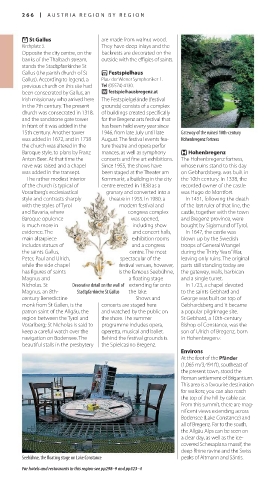
15th century. Another tower 1946, from late July until late Gateway of the ruined 10th-century
was added in 1672, and in 1738 August. The festival events fea- Hohen bregenz fortress
the church was altered in the ture theatre and opera perfor-
Baroque style, to plans by Franz mances, as well as symphony + Hohenbregenz
Anton Beer. At that time the concerts and fine art exhibitions. The Hohenbregenz fortress,
nave was raised and a chapel Since 1955, the shows have whose ruins stand to this day
was added in the transept. been staged at the Theater am on Gebhardsberg, was built in
The rather modest interior Kornmarkt, a building in the city the 10th century. In 1338, the
of the church is typical of centre erected in 1838 as a recorded owner of the castle
Vorarlberg’s ecclesiastical granary and converted into a was Hugo de Montfort.
style and contrasts sharply theatre in 1955. In 1980, a In 1451, following the death
with the styles of Tyrol modern festival and of the last ruler of that line, the
and Bavaria, where congress complex castle, together with the town
Baroque opulence was opened, and Bregenz province, were
is much more in including show bought by Sigismund of Tyrol.
evidence. The and concert halls, In 1647, the castle was
main altarpiece exhibition rooms blown up by the Swedish
includes statues of and a congress troops of General Wrangel
the saints Gallus, centre. The most during the Thirty Years’ War,
Peter, Paul and Ulrich, spectacular of the leaving only ruins. The original
while the side chapel festival venues, how ever, parts still standing today are
has figures of saints is the famous Seebühne, the gateway, walls, barbican
Magnus and a floating stage and a single turret.
Nicholas. St Decorative detail on the wall of extend ing far onto In 1723, a chapel devoted
Magnus, an 8th- Stadt pfarrkirche St Gallus the lake. to the saints Gebhard and
cen tury Benedictine Shows and George was built on top of
monk from St Gallen, is the concerts are staged here Gebhardsberg and it became
patron saint of the Allgäu, the and watched by the public on a popular pilgrimage site.
region between the Tyrol and the shore. The summer St Gebhard, a 10th-century
Vorarlberg; St Nicholas is said to programme includes opera, Bishop of Constance, was the
keep a careful watch over the operetta, musical and ballet. son of Ulrich of Bregenz, born
navigation on Bodensee. The Behind the festival grounds is in Hohenbregenz.
beautiful stalls in the presbytery the Spielcasino Bregenz.
Environs
At the foot of the Pfänder
(1,065 m/3,494 ft), southeast of
the present town, stood the
Roman settlement of Brigantium.
This area is a favourite destina tion
for walkers; you can also reach
the top of the hill by cable car.
From this summit, there are mag-
nificent views extending across
Bodensee (Lake Constance) and
all of Bregenz. Far to the south,
the Allgäu Alps can be seen on
a clear day, as well as the ice-
covered Schesaplana massif, the
deep Rhine ravine and the Swiss
Seebühne, the floating stage on Lake Constance peaks of Altmann and Säntis.
For hotels and restaurants in this region see pp298–9 and pp323–4
266-267_EW_Austria.indd 266 03/09/15 5:44 pm
Eyewitness Travel LAYERS PRINTED:
Catalogue template “UK” LAYER
(Source v2.1)
Date 5th December 2012
Size 125mm x 217mm

