


Page 275 - (DK Eyewitness) Travel Guide 2016 - Austria
P. 275
C arinthia and East t y rol 273
and Gothic structures. A fief secular buildings dating from
from the mid16th century, the 1st century AD. In spring
it later became the property of and summer, the finds can be
the Khevenhüller family, who viewed in the openair archaeo
own it to this day. Both fortress logical park and in the museum.
and fortifications are open to There is a small church on
visitors; the access road runs top of Magdalensberg, with a
in a loop between the old threeheaded stone statue in
walls, passing through 14 gates. the nave. This, as well as the
There is also a local museum. hilltop location of the church,
The turreted fortress of indicate the pagan, Celtic
Hochosterwitz is said to have origins of the area.
inspired Walt Disney’s animated
version of Snow White. 7 St Veit an Baroque stuccowork on the Rathaus façade,
der Glan St Veit an der Glan
8 Gurk
Road map E5. * 12,500. @ £
n Hauptplatz 23 (0664) 88736032. Road map E5. * 1,300. @ n Dr.
Schnerichstrasse 12 (04266) 812527.
From 1174 to 1518, St Veit an der
Glan was the seat of the dukes of Gurk, the former ecclesiastical
Spanheim, who ruled Carinthia capital of Carinthia, is domi nated
during the Middle Ages; it then by a cathedral church, built in
lost its position to Klagenfurt. 1140–1200 by Bishop Roman
Many historic buildings are and one of the most outstand
preserved in the old town around ing achievements of Austrian
Hauptplatz, including the Romanesque archi tecture. The
beautifully decorated Rathaus Gothic vestibule is adorned by
(town hall) of 1468, altered in the stainedglass windows (1340)
Baroque style. It has a lovely and Gothic frescoes. The original
16thcentury arcaded courtyard. main portal and door have
The 12th century Pfarrkirche carved and painted Romanesque
The slopes of Magdalensberg, site of St Veit (parish church of St Vitus) medallions. Inside it is a startling
fascinating archaeological finds con tains stone carvings from combi na tion of Romanesque and
various periods; the altars are Gothic, with net vaulting and a
6 Magdalensberg made in the Baroque style. Baroque main altar. The striking
The most recent symbol of crypt is supported by 100
Road map E5. * 3,300. n Deins
dorf 10, Pischeldorf (04224) 2213. St Veit is the unusual Kunsthotel columns. The cathedral houses
Fuchspalast, a modern hotel built the Diözesanmuseum, which
On top of Magdalene Hill, rising in 1998 to designs by the exhibits Austria’s largest collection
1,056 m (3,465 ft) from the Glan outstanding artist, Ernst Fuchs. of church furnishings as well as
valley, are the remains of a town It is themed around the signs of many early sacred art objects.
believed to be ancient Noricum, the zodiac. Also worth a visit is
dating from the lateCeltic and Museum St Veit, which covers E Diözesanmuseum
earlyRoman periods. Numerous the history of the local railways. Domplatz 11. Tel (04266) 8236.
finds, fragments of statues and Open May–Oct: 10am–
the remains of old altars testify 6pm daily. 8 at 3pm
to the overlapping nature of daily Jul & Aug.
Celtic and Roman cultures,
with some later Christian
additions. Below the
summit are the
scant remains
of a Roman
temple and
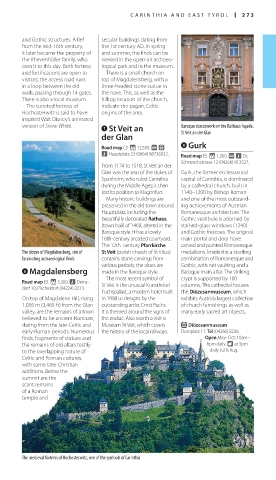
The medieval fortress of Hochosterwitz, one of the symbols of Carinthia
272-273_EW_Austria.indd 273 03/09/15 5:44 pm

