


Page 360 - (DK Eyewitness) Travel Guide 2016 - Austria
P. 360
358 Sur VIV A l G u I de
Getting Around Towns In Vienna, bike paths take you
around the Ringstrasse and
Finding your way around an unfamiliar town, even with a past many of the sights. Bikes
map, is often difficult. One-way traffic systems, pedestrianized may also be hired from some
areas and parking restrictions are all designed to keep car stations, at a discount if you
traffic out. Walking is the easiest and most enjoyable way have a train ticket.
to get around the compact city centres, where most of the One of the most scenic long-
distance cycling routes is the
historic sights are to be found. Austrian towns generally have Radweg (cycle track) along the
a well-developed public transport system, including buses Danube river.
and, in most cities, trams. Vienna also has an underground
network (metro) – the quickest way to reach any destination. Taxis
In some cities, travel cards give you unlimited travel on all
local transport facilities for a specified number of days. You can recognize a taxi by
the TAXI sign on the roof. They
are usually saloon cars,
Walking often Mercedes. If a
Pedestrians have priority, taxi is for hire, the sign
even on roads – but you should will be illuminated.
never rely on this. Try to use In the centre of a city
subways or crossings where it is easier to get a taxi
there are signals, especially at one of the taxi ranks,
when crossing wide roads with rather than hailing it
fast-moving traffic. Visitors from in the street. Taxi ranks
the UK and Australia need to can be found near
remember that motorists drive railway stations and
on the right. Do not cross a road large hotels.
when the red signal shows even Alternatively, you
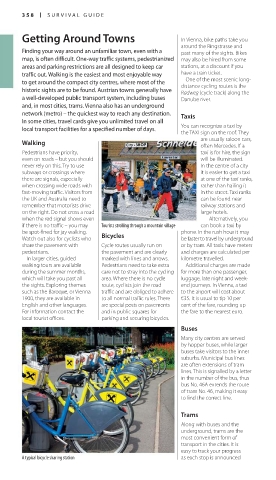
if there is no traffic – you may Tourists strolling through a mountain village can book a taxi by
be spot-fined for jay walking. Bicycles phone. In the rush hour it may
Watch out also for cyclists who be faster to travel by underground
share the pavement with Cycle routes usually run on or by tram. All taxis have meters
pedestrians. the pavement and are clearly and charges are calculated per
In larger cities, guided marked with lines and arrows. kilometre travelled.
walking tours are available Pedestrians need to take extra Additional charges are made
during the summer months, care not to stray into the cycling for more than one passenger,
which will take you past all area. Where there is no cycle luggage, late night and week-
the sights. Exploring themes route, cyclists join the road end journeys. In Vienna, a taxi
such as the Baroque, or Vienna traffic and are obliged to adhere to the airport will cost about
1900, they are available in to all normal traffic rules. There €35. It is usual to tip 10 per
English and other languages. are special posts on pavements cent of the fare, rounding up
For information contact the and in public squares for the fare to the nearest euro.
local tourist offices. parking and securing bicycles.
Buses
Many city centres are served
by hopper buses, while larger
buses take visitors to the inner
suburbs. Municipal bus lines
are often extensions of tram
lines. This is signalled by a letter
in the number of the bus, thus
bus No. 46A extends the route
of tram No. 46, making it easy
to find the correct line.
Trams
Along with buses and the
underground, trams are the
most convenient form of
transport in the cities. It is
easy to track your progress
A typical bicycle sharing station as each stop is announced
358-359_EW_Austria.indd 358 03/09/15 5:45 pm
Eyewitness Travel LAYERS PRINTED:
Practical template “UK” LAYER
(Source v1.6)
Date 7th January 2013
Size 125mm x 217mm

