


Page 11 - (DK Eyewitness) Back Roads Travel Guide - Great Britain
P. 11
Introducing Great Britain  9

       Introducing Great Britain


       The back roads of Great Britain are a refreshing   regions is waiting to be discovered. Take time
       antidote to the bustle of its world-famous cities.   to appreciate the landscapes, from the Scottish
       Though it is possible to zoom along motorways   Highlands to the Yorkshire Dales and the watery
       from London to Manchester, Cardiff, Glasgow or   Fens. Britain’s rural hills and fields, lined with
       Edinburgh in a few hours, it’s the smaller roads   stone walls and hedgerows, are quietly beautiful.
       away from these urban centres that lead into   The rest is stunning, from the Kent coast to the
       the true heart of the country. Here, through   Welsh mountains. Follow the back roads to find
       castles and ruined abbeys, and mining, farming   the farmers’ markets, pubs, festivals, gardens and
       and fishing villages, the rich history of Britain’s   wildlife that form the heart of the country.

       When to Go
       The itinerary for each of the drives    especially the further north you go,   Some traditional celebrations date
       offers suggestions on the best times   with dusk falling as early as 4pm.  back centuries and involve clog
       to visit. Some regions are known                dancing, inter-village football and
       for their gardens or their seasonal   Climate   other fun pastimes. Notable events
       produce, others for outdoor activities   Thanks to the Gulf Stream, Britain’s   include the Hay Festival of Literature
       from surfing to climbing. Festivals and   climate is moderate year-round and   (May), Cambridge Folk Festival (Jul),
       events can make for an unforgettable   seldom drops below freezing. Snow    and Highland Games, held in Scottish
       experience, so check with local tourist   is rare, except in mountainous areas.   towns Jun–Aug. Across the country,
       boards and consider these when   Average winter temperatures are    bonfires blaze and noisy fireworks
       planning your trip. The weather varies   5–10°C (40–50°F), while summers   flare into the sky on Guy Fawkes’
       by region. July and August generally   average 18–25°C (65–77°F), although   Night (5 Nov).
       guarantee the hottest, sunniest   they can rise to over 90°F (32°C). In
       weather but, for fewer crowds, April to  general, temperatures in the north are
       June and September to October are a   a few degrees lower than the south.   Public Holidays
       better bet. Summer’s other advantage  Spring comes first to the southwest,   New Year’s Day (1 Jan)
       is the long hours of daylight, especially   with gardens in Devon and Cornwall   Good Friday (Fri before Easter)
       in Scotland where darkness doesn’t fall   budding out in February and March.   Easter Monday
       until 10 or 11pm. Scenery is another   The western coast is usually rainier   May Day Holiday (1st Mon
       factor – spring can be magical with   and warmer than the east.  in May)
       bluebells, daffodils, colourful blossom          Spring Bank Holiday (last Mon
       and the brightest greens. Autumn   Festivals     in May)
       brings red and gold to the trees and   Many festivals and events, in villages   Summer Bank Holiday (last Mon
       purple heather on the moors. Winter   and market towns, centre around   in Aug)
       may be wetter and colder, but off-  regional produce from apples to   Christmas Day (25 Dec)
       season rates are cheaper and most   oysters to cheeses to wines. There    Boxing Day (26 Dec)
       attractions are open year-round.  are also craft fairs, music and the arts.
       Times to Avoid
       As mentioned already, July and
       August are the busiest times to visit –
       when British schools are on summer
       holiday and when the majority of
       foreign tourists arrive. Prices are
       also highest and traffic is heaviest,
       especially around popular coastal
       resorts. Throughout summer, biting
       insects known as midges are common
       in the western Highlands of Scotland.
       November–March has the rainiest,
       coldest weather and days are shorter,

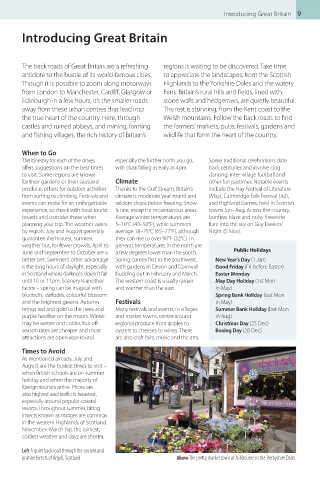
       Left A quiet back road through the ancient and
       pristine forests of Argyll, Scotland   Above The pretty market town of Ashbourne in the Derbyshire Dales


   008-009_Back_Roads_Great_Britain.indd   9                            30/03/2017   14:14

