


Page 74 - Khabar Magazine (February 2020)
P. 74
CoverStory


                  While  the total  number of  un-                               “For Indian nationals, there are back-
              documented immigrants may have                                      logs in both the family-based immi-
              gone down in recent times, it may                                   gration system and in the employ-
              be ironic to know that number of                                     ment-based system.  This means
              undocumented  Asians and par-                                        that family members may have
              ticularly Indians is on the rise. Ac-                                to remain apart for many years.
              cording to a study entitled  Inside                                 Sometimes they come to the U.S.
              the Numbers: How Immigration Shapes                                to join other family members on a
              Asian  American and Pacific Islander                              temporary or nonimmigrant visa,
              Communities conducted by Los Angeles-                           such as a tourist visa or a student visa,
              based civil rights organization                                      and when their status runs out,
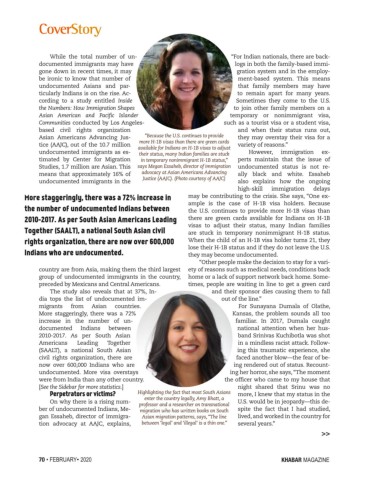
              Asian Americans Advancing  Jus-      “Because the U.S. continues to provide   they may overstay their visa for a
                                                 more H-1B visas than there are green cards
              tice (AAJC), out of the 10.7 million   available for Indians on H-1B visas to adjust   variety of reasons.”
              undocumented immigrants as es-     their status, many Indian families are stuck   However,  immigration  ex-
              timated by Center for Migration    in temporary nonimmigrant H-1B status,”   perts maintain that the issue of
              Studies, 1.7 million are Asian. This   says Megan Essaheb, director of immigration   undocumented status is not re-
              means that approximately 16% of     advocacy at Asian Americans Advancing   ally black and white. Essaheb
              undocumented immigrants in the      Justice (AAJC). (Photo courtesy of AAJC)  also explains how the ongoing
                                                                                   high-skill  immigration   delays
         More staggeringly, there was a 72% increase in           may be contributing to the crisis. She says, “One ex-
                                                                  ample is the case of H-1B visa holders. Because
         the number of undocumented Indians between               the U.S. continues to provide more H-1B visas than
         2010-2017. As per South Asian Americans Leading          there are green cards available for Indians on H-1B
                                                                  visas to adjust their status, many Indian families
         Together (SAALT), a national South Asian civil           are stuck in temporary nonimmigrant H-1B status.
         rights organization, there are now over 600,000          When the child of an H-1B visa holder turns 21, they
                                                                  lose their H-1B status and if they do not leave the U.S.
         Indians who are undocumented.                            they may become undocumented.

                                                                      “Other people make the decision to stay for a vari-
              country are from Asia, making them the third largest   ety of reasons such as medical needs, conditions back
              group of undocumented immigrants in the country,    home or a lack of support network back home. Some-
              preceded by Mexicans and Central Americans.         times, people are waiting in line to get a green card
                  The study also reveals that at 37%, In-                 and their sponsor dies causing them to fall
              dia  tops the  list  of  undocumented  im-                     out of the line.”
              migrants   from   Asian   countries.                                 For Sunayana Dumala of Olathe,
              More staggeringly, there was a 72%                                 Kansas, the problem sounds all too
              increase in the number of un-                                       familiar. In 2017, Dumala caught
              documented     Indians  between                                      national attention when her hus-
              2010-2017. As  per  South Asian                                      band Srinivas Kuchibotla was shot
              Americans    Leading    Together                                     in a mindless racist attack. Follow-
              (SAALT), a national South  Asian                                     ing this traumatic experience, she
              civil rights organization, there are                                faced another blow—the fear of be-
              now over 600,000 Indians who are                                   ing rendered out of status. Recount-
              undocumented. More visa overstays                                 ing her horror, she says, “The moment
              were from India than any other country.                         the officer who came to my house that
              [See the Sidebar for more statistics.]                               night shared that Srinu was no
                  Perpetrators or victims?      Highlighting the fact that most South Asians   more, I knew that my status in the
                                                   enter the country legally, Amy Bhatt, a
                  On why there is a rising num-  professor and a researcher on transnational   U.S. would be in jeopardy—this de-
              ber of undocumented Indians, Me-   migration who has written books on South   spite the fact that  I had studied,
              gan Essaheb, director of immigra-   Asian migration patterns, says, “The line   lived, and worked in the country for
              tion advocacy at  AAJC, explains,   between ‘legal’ and ‘illegal’ is a thin one.”  several years.”
                                                                                                                >>


              70 • FEBRUARY• 2020                                                                  KHABAR MAGAZINE

