


Page 116 - (DK Eyewitness) Travel Guide - Prague
P. 116
114 PR A GUE AREA B Y AREA
Exploring the Sternberg Collections significance for Prague since
it was bought by Emperor
The National Gallery’s collection of European art at the Rudolph II. The two figures in
Sternberg Palace ranks among the country’s best collections. front of the Virgin and Child
The museum is divided into three separate viewing areas. are Maximilian I (Rudolph’s
Its extensive holdings of German and Austrian art of the 15th great-great-grandfather) and
Pope Julius II.
to 19th centuries are exhibited just off the courtyard on the The collection also includes
ground floor. A small collection of art from antiquity and works by several other impor-
religious icons, as well as a larger display of early Italian and tant German painters of the
Dutch art, occupy the first floor. Most of the real treasures Renaissance, including Hans
are on the second floor, where the museum displays works Holbein the Elder and the
Younger and Lucas Cranach the
of Italian, Spanish, French and Dutch masters from the 16th Elder. Cranach is represented by
to 18th centuries. a striking Adam and Eve, whose
nudes show the spirit of the
Icons, Classical and Renaissance, tempered by
Ancient Art Lutheran Reform.
Two small rooms on the first Italian Art (1400–1700)
floor are occupied by an odd
assortment of paintings that do When you enter the gallery of
not quite fit in with the rest of early Italian art on the first floor,
the collection. These include a you are greeted by a splendid
Portrait of a Young Woman dating array of richly gilded early
from the 2nd century AD, diptychs and triptychs from
which was discovered during the churches of Tuscany and
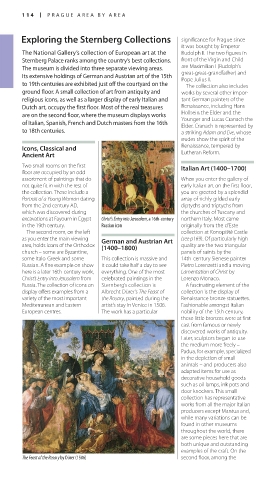
excavations at Fayoum in Egypt Christ’s Entry into Jerusalem, a 16th-century northern Italy. Most came
in the 19th century. Russian icon originally from the d’Este
The second room, on the left collection at Konopiště Castle
as you enter the main viewing German and Austrian Art (see p169). Of particularly high
area, holds icons of the Orthodox (1400–1800) quality are the two triangular
church – some are Byzantine, panels of saints by the
some Italo-Greek and some This collection is massive and 14th-century Sienese painter
Russian. A fine example on show it could take half a day to see Pietro Lorenzetti and a moving
here is a later 16th-century work, everything. One of the most Lamentation of Christ by
Christ’s Entry into Jerusalem from celebrated paintings in the Lorenzo Monaco.
Russia. The collection of icons on Sternberg’s collection is A fascinating element of the
display offers examples from a Albrecht Dürer’s The Feast of collection is the display of
variety of the most important the Rosary, painted during the Renaissance bronze statuettes.
Mediterranean and Eastern artist’s stay in Venice in 1506. Fashionable amongst Italian
European centres. The work has a particular nobility of the 15th century,
these little bronzes were at first
cast from famous or newly
discovered works of antiquity.
Later, sculptors began to use
the medium more freely –
Padua, for example, specialized
in the depiction of small
animals – and producers also
adapted items for use as
decorative household goods
such as oil lamps, ink pots and
door knockers. This small
collection has representative
works from all the major Italian
producers except Mantua and,
while many variations can be
found in other museums
throughout the world, there
are some pieces here that are
both unique and outstanding
examples of the craft. On the
The Feast of the Rosary by Dürer (1506) second floor, among the
114-115_EW_Prague.indd 114 22/03/2017 12:30

