


Page 163 - (DK Eyewitness) Travel Guide - Prague
P. 163
FUR THER AFIELD 161
exhibit is the paper and wood
model of Prague by Antonín
Langweil. Completed in 1834,
it covers 20 sq m (25 sq yards).
The scale of the extraordinarily
accurate model is 1:500.
6 Letná Park
Letenské Sady
Map 3 A1. X Malostranská,
Hradčanská. v 1, 5, 8, 12, 17,
18, 20, 22, 25, 26.
Across the river from the
Jewish Quarter, a large plateau
overlooks the city. It was here
that armies gathered before
Relief by Josef Myslbek on the portal of St Ludmilla in Náměstí Míru attacking Prague Castle. Since
the mid-19th century, it has
Žižkov’s main landmark is the 5 Prague Museum been a wooded park.
nearby television transmitter, at Muzeum Hlavního Města Prahy On the terrace at the top of
216 m (709 ft) the city’s tallest the granite steps that lead up
building. Ten giant sculptures of Na Poříčí 52. Map 4 F3. Tel 22 48 from the embankment stands
babies by Czech artist David 16 773. X Florenc. v 3, 8. a curious monument – a giant
Černý crawl on its outside. Open 9am–6pm Tue–Sun. & metronome built in 1991. It
∑ muzeumprahy.cz
was installed after the Velvet
Revolution on the pedestal
4 Náměstí Míru The collection records the history formerly occupied by the
Map 6 F2. X Náměstí Míru. v 4, 10, of Prague from primeval times. gigantic stone statue of Stalin
16, 22. @ 135. Church of St Ludmila: A new museum was built to leading the people, which was
Open Apr–Sep: 9am–4pm Mon–Sat, house the exhibits in the 1890s. blown up in 1962. A far more
noon–4pm Sun. 5 4:30pm daily, Its Neo-Renaissance façade is durable monument is the
9am, 11am & 4:30pm Sun. rich with stucco and sculptures, Hanavský Pavilion, a Neo-
∑ ludmilavinohrady.cz and the interior walls are Baroque cast iron structure,
painted with historic views built for the 1891 Exhibition.
This attractive square, with a of the city. Some of the It was later dismantled and
well-kept central garden, is impressive items on display erected on its present site in
the focal point of the mostly include examples of Prague the park, where it houses a
residential Vinohrady quarter. china and furniture, relics popular restaurant and café.
At the top of its sloping lawns of the medieval guilds and The park has a popular beer
stands the attractive, brick Neo- paintings of Prague through garden in summer at its
Gothic Church of St Ludmila the ages. The most remarkable eastern end.
(1888–93), designed by Josef
Mocker, architect of the west
end of St Vitus’s Cathedral (see
pp102–105). Its twin octagonal
spires are 60 m (200 ft) high.
On the tympanum of the main
portal is a relief of Christ with
St Wenceslas and St Ludmila by
the great 19th-century sculptor
Josef Myslbek. Leading artists
also contributed designs for the
stained-glass windows.
The outside of the square is
lined with attractive buildings,
including the Vinohrady Theatre
(see p219), a spirited Art Nouveau
building com pleted in 1907.
The façade is crowned by two
huge winged fig ures sculpted
by Milan Havlíček, symbolizing
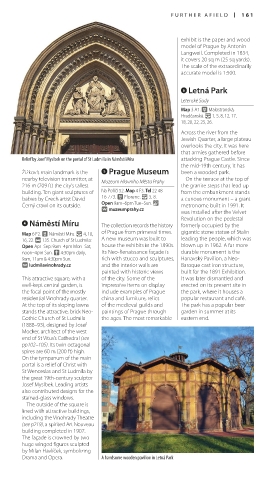
Drama and Opera. A handsome wooden pavilion in Letná Park
160-161_EW_Prague.indd 161 20/03/17 11:29 am

