


Page 21 - (DK Eyewitness) Travel Guide - Prague
P. 21
INTRODUCING PR A GUE 19
THE HISTORY
OF PRAGUE
Prague’s position at the crossroads of of Lipany in 1434. During the 16th century,
Europe has made it a magnet for foreign after a succession of weak kings, the Habs-
traders since prehistoric times. By the burgs gained control, beginning a rule that
early 10th century, Prague had become would last for almost 400 years. One of the
a thriving town with a large market place, more enlightened of all the Habsburg
the Old Town Square, and two citadels, Emperors was Rudolph II. He brought the
Prague Castle and Vyšehrad, from where its spirit of the Renaissance to Prague through
first rulers, the Přemyslids, conducted their his love of the arts and sciences. Soon after his
many family feuds. These were often bloody: death, in 1618, Prague was the setting for the
in AD 935, Prince Wenceslas was murdered Protestant revolt which led to the Thirty Years’
by his brother Boleslav. Wenceslas was War. The war’s aftermath caused a serious
later canonized and became the Czechs’ decline in the fortunes of the city that
best-known patron saint. would revive only in the 18th century.
During the Middle Ages, Prague prospered, Prague’s many fine Baroque churches
especially during the reign of the Holy Roman and palaces date from this time.
Emperor, Charles IV. Under the government The 19th century saw a period of national
of this wise and cultured ruler, Prague grew revival and the burgeoning of civic pride.
into a magnificent city, larger than Paris or The great public monuments – the National
London. Charles instigated the founding Museum, National Theatre and Rudolfinum
and building of many institutions in Prague, – were built. But the Habsburgs still ruled
including the first university in Central the city, and it was not until 1918 that Prague
Europe, Charles University. One of the became the capital of an indepen dent
University’s first Czech rectors was Jan Hus, Republic. World War II brought occupation
the reforming preacher whose execution by the German army, followed by four
for alleged heresy in 1415 led to the Hussite decades of Communism. After the “Velvet
wars. The radical wing of the Hussites, the Revolution” of 1989, Prague embraced
Taborites, were finally defeated at the Battle a new era as a modern European capital.
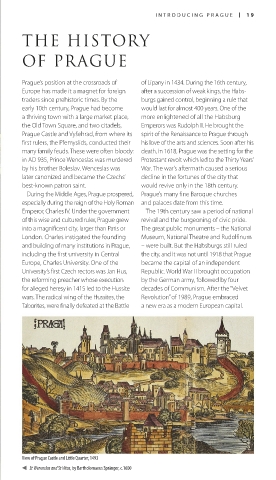
View of Prague Castle and Little Quarter, 1493
St Wenceslas and St Vitus, by Bartholomaeus Spränger, c.1600
018-019_EW_Prague.indd 19 28/04/2017 16:49

