


Page 159 - (DK Eyewitness) Travel Guide - New Orleans
P. 159
LAF A Y E T TE 157
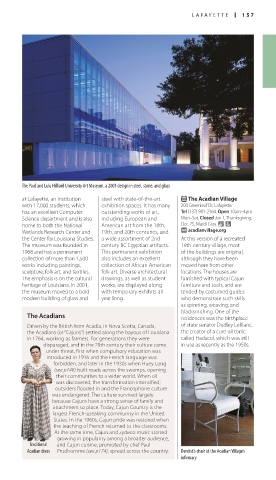
The Paul and Lulu Hilliard University Art Museum, a 2001 design in steel, stone, and glass
at Lafayette, an institution steel with state-of-the-art E The Acadian Village
with 17,000 students, which exhibition spaces. It has many 200 Greenleaf Dr, Lafayette.
has an excellent Computer outstanding works of art, Tel (337) 981-2364. Open 10am–4pm
Science department and is also including European and Mon–Sat. Closed Jan 1, Thanksgiving,
home to both the National American art from the 18th, Dec 25, Mardi Gras. & 7
Wetlands Research Center and 19th, and 20th centuries, and ∑ acadianvillage.org
the Center for Louisiana Studies. a wide assortment of 2nd At this version of a recreated
The museum was founded in century BC Egyptian artifacts. 19th-century village, most
1968 and has a permanent This permanent exhibition of the buildings are original,
collection of more than 1,500 also includes an excellent although they have been
works including paintings, collection of African American moved here from other
sculpture, folk art, and textiles. folk art. Diverse architectural locations. The houses are
The emphasis is on the cultural drawings, as well as student furnished with typical Cajun
heritage of Louisiana. In 2001, works, are displayed along furniture and tools, and are
the museum moved to a bold with temporary exhibits all tended by costumed guides
modern building of glass and year long. who demonstrate such skills
as spinning, weaving, and
blacksmithing. One of the
The Acadians residences was the birthplace
Driven by the British from Acadia, in Nova Scotia, Canada, of state senator Dudley LeBlanc,
the Acadians (or “Cajuns”) settled along the bayous of Louisiana the creator of a cure-all tonic
in 1764, working as farmers. For generations they were called Hadacol, which was still
disparaged, and in the 20th century their culture came in use as recently as the 1950s.
under threat, first when compulsory education was
introduced in 1916 and the French language was
forbidden, and later in the 1930s when Huey Long
(see p148) built roads across the swamps, opening
their communities to a wider world. When oil
was discovered, the transformation intensified;
outsiders flooded in and the Francophone culture
was endangered. The culture survived largely
because Cajuns have a strong sense of family and
attachment to place. Today, Cajun Country is the
largest French-speaking community in the United
States. In the 1960s, Cajun pride was restored when
the teaching of French returned to the classrooms.
At the same time, Cajun and zydeco music started
growing in popularity among a broader audience,
Traditional and Cajun cuisine, promoted by chef Paul
Acadian dress Prudhomme (see p174), spread across the country. Dentist’s chair at the Acadian Village’s
infirmary
156-157_EW_New_Orl.indd 157 05/08/16 3:50 pm

