


Page 20 - BBC Wildlife Volume 36 #12
P. 20
RED DEER


                            he wind is straight out
                            of the north and bites
                            at my face. Cresting
                            the whaleback ridge, a
                            breathtaking panorama
                            emerges – a raw, wild
           Tmoonscape stretching far
            beyond a horizon I can barely discern. This
            unforgiving landscape is quintessentially
            Scottish. It’s the signature landscape of
            the Highlands, dominated by hundreds
            of thousands of acres of bare moorland,
            rock and bog. In front of me lies Inverpolly
            Forest, undoubtedly spectacular, but barely
            a tree, or even a bush, to be seen. This
            is a traditional hunting forest or, more
            specifically, a deer hunting forest, which by
            definition contains few trees.
              In 1851 when celebrated artist Sir Edwin
            Landseer depicted a royal stag against the
            majesty of the Highlands, he created an
            evocative and enduring image of Scotland’s
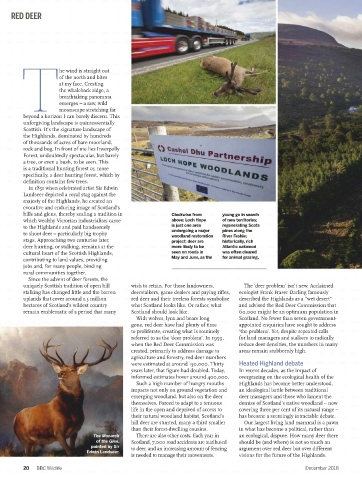
            hills and glens, thereby sealing a tradition in                     Clockwise from          young go in search
            which wealthy Victorian industrialists came                         above: Loch Hope        of new territories;
            to the Highlands and paid handsomely                                is just one area        regenerating Scots
                                                                                undergoing a major      pines along the
            to shoot deer – particularly big trophy
                                                                                woodland restoration    River Feshie;
            stags. Approaching two centuries later,                             project; deer are       historically, rich
            deer hunting, or stalking, remains at the                           more likely to be       Atlantic oakwood
            cultural heart of the Scottish Highlands,                           seen on roads in        was often cleared
                                                                                May and June, as the    for animal grazing.
            contributing to land values, providing
            jobs and, for many people, binding
            rural communities together.
              Since the advent of deer forests, the
            uniquely Scottish tradition of open hill          wish to retain. For those landowners,               The ‘deer problem’ isn’t new. Acclaimed
            stalking has changed little and the barren        deerstalkers, game dealers and paying rifles,     ecologist Frank Fraser Darling famously
            uplands that cover around 1.5 million             red deer and their treeless forests symbolise    described the Highlands as a “wet desert”
            hectares of Scotland’s wildest country            what Scotland looks like. Or rather, what        and advised the Red Deer Commission that
            remain emblematic of a period that many           Scotland should look like.                       60,000 might be an optimum population in
                                                                With wolves, lynx and bears long               Scotland. No fewer than seven government-
                                                              gone, red deer have had plenty of time           appointed enquiries have sought to address
                                                              to proliferate, creating what is routinely       ‘the problem’. Yet, despite repeated calls
                                                              referred to as the ‘deer problem’. In 1959,      for land managers and stalkers to radically
                                                              when the Red Deer Commission was                 reduce deer densities, the numbers in many
                                                              created, primarily to address damage to          areas remain stubbornly high.
                                                              agriculture and forestry, red deer numbers
                                                              were estimated at around 150,000. Thirty         Heated Highland debate
                                                              years later, that figure had doubled. Today,      In recent decades, as the impact of
                                                              informed estimates hover around 400,000.         overgrazing on the ecological health of the
                                                                Such a high number of hungry mouths            Highlands has become better understood,
                                                              impacts not only on ground vegetation and        an ideological battle between traditional
                                                              emerging woodland, but also on the deer          deer managers and those who lament the
                                                              themselves. Forced to adapt to a tenuous         demise of Scotland’s native woodland – now
                                                              life in the open and deprived of access to       covering three per cent of its natural range –
                                                              their natural woodland habitat, Scotland’s       has become a seemingly intractable debate.
                                                              hill deer are stunted, many a third smaller         Our largest living land mammal is a pawn
                                                              than their forest-dwelling cousins.              in what has become a political, rather than
                                            The Monarch         There are also other costs. Each year in       an ecological, dispute. How many deer there
                                             of the Glen,     Scotland, 7,000 road accidents are attributed    should be (and where) is not so much an
                                           painted by Sir     to deer, and an increasing amount of fencing     argument over red deer but over different
                                         Edwin Landseer.
                                                              is needed to manage their movements.             visions for the future of the Highlands.

            20    BBC Wildlife                                                                                                                December 2018

