


Page 29 - The Dinosaur Book and Other Wonders of the Prehistoric World (DK-Smithsonian)
P. 29
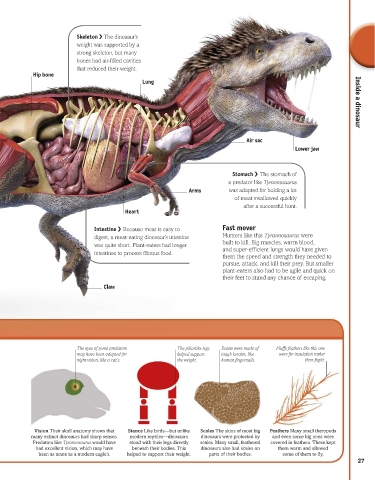
Skeleton ❯ The dinosaur’s
                          weight was supported by a
                          strong skeleton, but many
                          bones had air-filled cavities
                          that reduced their weight.
            Hip bone
                                                Lung                                                                 Inside a dinosaur


                                                                                  Air sac
                                                                                                 Lower jaw


                                                                             Stomach ❯ The stomach of
                                                                            a predator like Tyrannosaurus
                                                               Arms         was adapted for holding a lot
                                                                              of meat swallowed quickly
                                                                                 after a successful hunt.
                                          Heart


                                Intestine ❯ Because meat is easy to       Fast mover
                                digest, a meat-eating dinosaur’s intestine   Hunters like this Tyrannosaurus were
                                was quite short. Plant-eaters had longer   built to kill. Big muscles, warm blood,
                                intestines to process fibrous food.       and super-efficient lungs would have given
                                                                          them the speed and strength they needed to
                                                                          pursue, attack, and kill their prey. But smaller
                                                                          plant-eaters also had to be agile and quick on
                                                                          their feet to stand any chance of escaping.
                                   Claw


                          The eyes of some predators       The pillarlike legs   Scales were made of   Fluffy feathers like this one
                          may have been adapted for        helped support    tough keratin, like   were for insulation rather
                          night vision, like a cat’s.      the weight.   human fingernails.          than flight.


            Vision Their skull anatomy shows that   Stance Like birds—but unlike   Scales The skins of most big   Feathers Many small theropods
           many extinct dinosaurs had sharp senses.   modern reptiles—dinosaurs   dinosaurs were protected by   and even some big ones were
            Predators like Tyrannosaurus would have   stood with their legs directly   scales. Many small, feathered   covered in feathers. These kept
             had excellent vision, which may have   beneath their bodies. This   dinosaurs also had scales on   them warm and allowed
              been as acute as a modern eagle’s.   helped to support their weight.  parts of their bodies.  some of them to fly.
                                                                                                                      27


   US_026-027_Inside_a_Dinosaur.indd   27                                                                        10/04/18   3:32 PM

