


Page 90 - All About History - Issue 29-15
P. 90
Five minutes with
        TERRYDEARY


        THE BESTSELLING AUTHOR OF HORRIBLE HISTORIES
        TELLS US WHY HIS BOOKS AND PLAYS BREAK THE
        MOULD OF HISTORICAL NONFICTION


                    What do you think it is about the
                    Horrible Histories stage shows that
                    has made them such a success?
                    It attracts a lot of schools because it’s
                    educational as well as entertainment. Of
                    course, the books themselves are a well-
                    known brand, so people who wouldn’t
                    normally go to the theatre see it
        advertised and think “oh, we can see it in a different
        format, without having to read the books.”
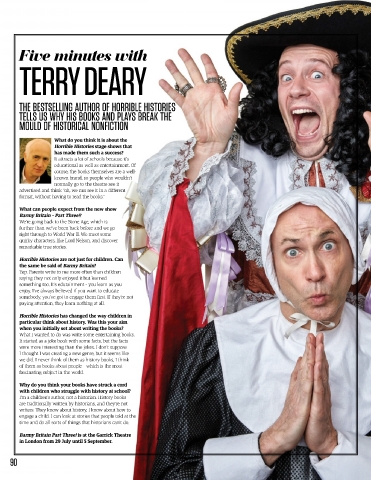
        What can people expect from the new show
        Barmy Britain – Part Three!?
        We’re going back to the Stone Age, which is
        further than we’ve been back before and we go
        right through to World War II. We meet some
        quirky characters, like Lord Nelson, and discover
        remarkable true stories.
        Horrible Histories are not just for children. Can
        the same be said of Barmy Britain?
        Yep. Parents write to me more often than children
        saying they not only enjoyed it but learned
        something too. It’s edutainment – you learn as you
        enjoy. I’ve always believed if you want to educate
        somebody, you’ve got to engage them first. If they’re not
        paying attention, they learn nothing at all.

        Horrible Histories has changed the way children in
        particular think about history. Was this your aim
        when you initially set about writing the books?
        What I wanted to do was write some entertaining books.
        It started as a joke book with some facts, but the facts
        were more interesting than the jokes. I don’t suppose
        I thought I was creating a new genre, but it seems like
        we did. I never think of them as history books, I think
        of them as books about people – which is the most
        fascinating subject in the world.

        Why do you think your books have struck a cord
        with children who struggle with history at school?
        I’m a children’s author, not a historian. History books
        are traditionally written by historians, and they’re not
        writers. They know about history, I know about how to
        engage a child. I can look at stories that people told at the
        time and do all sorts of things that historians can’t do.

        Barmy Britain Part Three! is at the Garrick Theatre
        in London from 29 July until 5 September.


     90

