


Page 116 - (DK Eyewitness) Travel Guide - Spain
P. 116
114 NOR THERN SP AIN
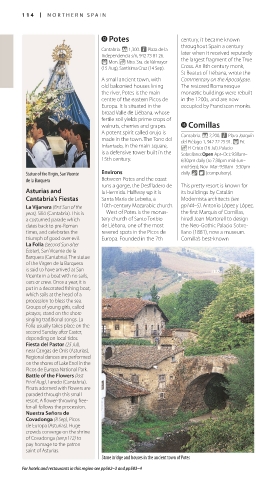
w Potes century, it became known
throughout Spain a century
Cantabria. * 1,300. n Plaza de la
Independencia s/n, 942 73 81 26. later when it received reput edly
( Mon. _ Ntra. Sra. de Valmayor the largest fragment of the True
(15 Aug), Santísima Cruz (14 Sep). Cross. An 8th century monk,
St Beatus of Liéb ana, wrote the
A small ancient town, with Commentary on the Apocalypse.
old balconied houses lining The restored Romanesque
the river, Potes is the main monastic buildings were rebuilt
centre of the eastern Picos de in the 1200s, and are now
Europa. It is situated in the occupied by Franciscan monks.
broad Valle de Liébana, whose
fertile soil yields prime crops of
walnuts, cherries and grapes. e Comillas
A potent spirit called orujo is Cantabria. * 2,200. n Plaza Joaquín
made in the town. The Torre del del Piélago 1, 942 72 25 91. ( Fri.
Infantado, in the main square, _ El Cristo (16 Jul). Palacio
is a defensive tower built in the Sobrellano: Open Apr–Oct: 9:30am–
15th century. 6:30pm daily (to 7:30pm mid-Jun–
mid-Sep); Nov–Mar: 9:30am–3:30pm
Statue of the Virgin, San Vicente Environs daily. & 8 (compulsory).
de la Barquera Between Potes and the coast
runs a gorge, the Desfiladero de This pretty resort is known for
Asturias and la Hermida. Halfway up it is its buildings by Catalán
Cantabria’s Fiestas Santa María de Lebeña, a Modernista architects (see
La Vijanera (first Sun of the 10th-century Mozarabic church. pp144–5). Antonio López y López,
year), Silió (Cantabria). This is West of Potes is the monas- the first Marquis of Comillas,
a costumed parade which tery church of Santo Toribio hired Joan Martorell to design
dates back to pre-Roman de Liébana, one of the most the Neo-Gothic Palacio Sobre-
times, and celebrates the revered spots in the Picos de llano (1881), now a museum.
triumph of good over evil. Europa. Founded in the 7th Comilla’s best-known
La Folía (second Sun after
Easter), San Vicente de la
Barquera (Cantabria). The statue
of the Virgen de la Barquera
is said to have arrived at San
Vicente in a boat with no sails,
oars or crew. Once a year, it is
put in a decorated fishing boat,
which sails at the head of a
procession to bless the sea.
Groups of young girls, called
picayos, stand on the shore
singing traditional songs. La
Folía usually takes place on the
second Sunday after Easter,
depending on local tides.
Fiesta del Pastor (25 Jul),
near Cangas de Onís (Asturias).
Regional dances are performed
on the shores of Lake Enol in the
Picos de Europa National Park.
Battle of the Flowers (last
Fri of Aug), Laredo (Cantabria).
Floats adorned with flowers are
paraded through this small
resort. A flower-throwing free-
for-all follows the procession.
Nuestra Señora de
Covadonga (8 Sep), Picos
de Europa (Asturias). Huge
crowds converge on the shrine
of Covadonga (see p112) to
pay homage to the patron
saint of Asturias.
Stone bridge and houses in the ancient town of Potes
For hotels and restaurants in this region see pp562–3 and pp583–4
114-115_EW_Spain.indd 114 26/09/17 11:00 am
Eyewitness Travel LAYERS PRINTED:
Catalogue template “UK” LAYER
(Source v2.1)
Date 5th December 2012
Size 125mm x 217mm

