


Page 221 - (DK Eyewitness) Travel Guide - Spain
P. 221
C A T AL ONIA 219
Bofill, is the widest Gothic span r Figueres
in Christendom. Behind the altar
is a marble throne known as Girona. * 45,000. £ @ n Plaça
“Charlemagne’s Chair” after the de l’Escorxador 2, 972 50 31 55. (
Thu. _ Santa Creu (3 May), Sant Pere
Frankish king whose troops took (29 Jun). ∑ visitfigueres.cat
Girona in 785. In the chancel is
a 14th-century jewel-encrusted Figueres is in the north of the
silver and enamel altarpiece. In Empordà (Ampurdán) region,
the mu seum are Romanesque the fertile plain that sweeps
paint ings and statues such as a inland from the Gulf of Roses.
14th-century statue of the Catalan Every Thursday, the market
king, Pere the Ceremonious, here fills with fruit and
and a 10th-century illuminated vegetables from the area.
copy of St Beatus of Liébana’s The Museu del Joguet (Toy
Commentary on the Apocalypse. Museum) is housed on the top
The collection’s most famous floor of the old Hotel de Paris,
item is a large, well-preserved on the Rambla, Figueres’ main
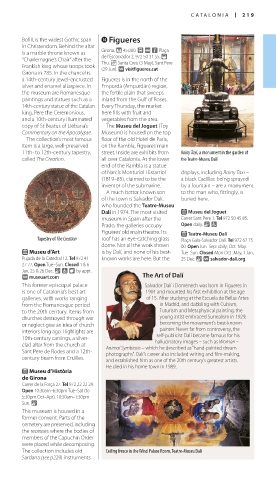
11th- to 12th-century tapestry, street. Inside are exhibits from Rainy Taxi, a monument in the garden of
called The Creation. all over Catalonia. At the lower the Teatre-Museu Dalí
end of the Rambla is a statue
of Narcís Monturiol i Estarriol displays, including Rainy Taxi –
(1819–85), claimed to be the a black Cadillac being sprayed
inventor of the submarine. by a fountain – are a monument
A much better known son to the man who, fittingly, is
of the town is Salvador Dalí, buried here.
who founded the Teatre-Museu
Dalí in 1974. The most visited E Museu del Joguet
museum in Spain after the Carrer Sant Pere 1. Tel 972 50 45 85.
Prado, the galleries occupy Open daily. & 7
Figueres’ old main theatre. Its E Teatre-Museu Dalí
Tapestry of The Creation roof has an eye-catching glass Plaça Gala-Salvador Dalí. Tel 972 67 75
dome. Not all the work shown 00. Open Jun–Sep: daily; Oct–May:
E Museu d’Art is by Dalí, and none of his best- Tue–Sun. Closed Mon Oct–May, 1 Jan,
Pujada de la Catedral 12. Tel 972 41 known works are here. But the 25 Dec. & ∑ salvador-dali.org
27 77. Open Tue–Sun. Closed 1 & 6
Jan, 25 & 26 Dec. & 7 8 by appt.
∑ museuart.com The Art of Dalí
This former episcopal palace Salvador Dalí i Domènech was born in Figueres in
is one of Catalonia’s best art 1904 and mounted his first exhibition at the age
galleries, with works ranging of 15. After studying at the Escuela de Bellas Artes
from the Romanesque period in Madrid, and dabbling with Cubism,
to the 20th century. Items from Futurism and Metaphysical painting, the
churches destroyed through war young artist embraced Surrealism in 1929,
or neglect give an idea of church becoming the movement’s best-known
interiors long ago. Highlights are painter. Never far from controversy, the
self-publicist Dalí became famous for his
10th-century carvings, a silver- hallucinatory images – such as Woman –
clad altar from the church at Animal Symbiosis – which he described as “hand-painted dream
Sant Pere de Rodes and a 12th- photographs”. Dalí’s career also included writing and film-making,
century beam from Cruïlles. and established him as one of the 20th century’s greatest artists.
He died in his home town in 1989.
E Museu d’Història
de Girona
Carrer de la Força 27. Tel 972 22 22 29.
Open 10:30am–6:30pm Tue–Sat (to
5:30pm Oct–Apr), 10:30am–1:30pm
Sun. &
This museum is housed in a
former convent. Parts of the
cemetery are preserved, including
the recesses where the bodies of
members of the Capuchin Order
were placed while decomposing.
The col lection includes old Ceiling fresco in the Wind Palace Room, Teatre-Museu Dalí
Sardana (see p229) instruments.
218-219_EW_Spain.indd 219 26/09/17 11:01 am

