


Page 268 - (DK Eyewitness) Travel Guide - Spain
P. 268
266 EASTERN SP AIN
The cathedral museum
displays grand Gothic altar
pieces, a frieze from a Roman
sarcophagus and the third
largest monstrance in Spain.
Francisco Salzillo (1707–83),
one of Spain’s greatest sculp tors,
was born in Murcia, and a
museum in the Iglesia de Jesús
(Church of Jesus) exhibits nine
of his pasos – sculptures on
platforms. These are carried
through the streets on Good
Friday morning. The figures are
so lifelike that a fellow sculptor
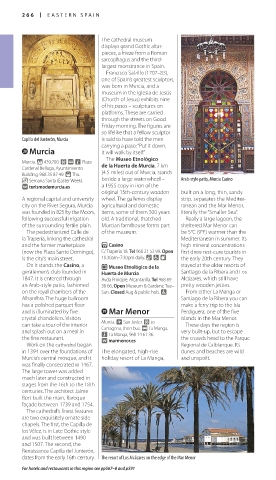
Capilla del Junterón, Murcia is said to have told the men
carrying a paso: “Put it down,
k Murcia it will walk by itself.”
The Museo Etnológico
Murcia. * 439,700. £ @ n Plaza
Cardenal Belluga, Ayuntamiento de la Huerta de Murcia, 7 km
Building, 968 35 87 49. ( Thu. (4.5 miles) out of Murcia, stands
_ Semana Santa (Easter Week). beside a large waterwheel – Arab-style patio, Murcia Casino
∑ turismodemurcia.es a 1955 copy in iron of the
original 15thcentury wooden built on a long, thin, sandy
A regional capital and university wheel. The galleries dis play strip, separates the Mediter
city on the River Segura, Murcia agricultural and domestic ranean and the Mar Menor,
was founded in 825 by the Moors, items, some of them 300 years literally the “Smaller Sea”.
following successful irrigation old. A traditional, thatched Really a large lagoon, the
of the surrounding fertile plain. Murcian farmhouse forms part sheltered Mar Menor can
The pedestrianized Calle de of the museum. be 5°C (9°F) warmer than the
la Trapería, linking the cathedral Mediterranean in summer. Its
and the former marketplace P Casino high mineral concentrations
(now the Plaza Santo Domingo), C/ Trapería 18. Tel 968 21 53 99. Open first drew restcure tourists in
is the city’s main street. 10:30am–7:30pm daily. & 7 8 the early 20th century. They
On it stands the Casino, a E Museo Etnológico de la stayed at the older resorts of
gentlemen’s club founded in Huerta de Murcia Santiago de la Ribera and Los
1847. It is entered through Avda Principe, Alcantarilla. Tel 968 89 Alcázares, which still have
an Arabstyle patio, fashioned 38 66. Open Museum & Gardens: Tue– pretty wooden jetties.
on the royal chambers of the Sun. Closed Aug & public hols. 7 From either La Manga or
Alhambra. The huge ballroom Santiago de la Ribera you can
has a polished parquet floor make a ferry trip to the Isla
and is illuminated by five l Mar Menor Perdiguera, one of the five
crystal chandeliers. Visitors islands in the Mar Menor.
can take a tour of the interior Murcia. ~ San Javier. £ to These days the region is
Cartagena, then bus. @ La Manga.
and splash out on a meal in n La Manga, 968 14 61 36. very builtup, but to escape
the fine restaurant. ∑ marmenor.es the crowds head to the Parque
Work on the cathedral began Regional de Calblanque. Its
in 1394 over the found ations of The elongated, highrise dunes and beaches are wild
Murcia’s central mosque, and it holiday resort of La Manga, and unspoilt.
was finally consecrated in 1467.
The large tower was added
much later and constructed in
stages from the 16th to the 18th
centuries. The architect Jaime
Bort built the main, Baroque
façade between 1739 and 1754.
The cathedral’s finest features
are two exquisitely ornate side
chapels. The first, the Capilla de
los Vélez, is in Late Gothic style
and was built between 1490
and 1507. The second, the
Renaissance Capilla del Junterón,
dates from the early 16th century. The resort of Los Alcázares on the edge of the Mar Menor
For hotels and restaurants in this region see pp567–8 and p591
266-267_EW_Spain.indd 266 26/09/17 11:01 am
Eyewitness Travel LAYERS PRINTED:
Catalogue template “UK” LAYER
(Source v2.1)
Date 5th December 2012
Size 125mm x 217mm

