


Page 446 - (DK Eyewitness) Travel Guide - Spain
P. 446
444 SE VILLE
4 Casa de Pilatos
Plaza de Pilatos 1. Map 4 D1. Tel 95
422 52 98. @ C3, C4, C5, 21, 24, 27.
Open 9am–6pm daily (to 7pm Jul
& Aug). & 8 first floor. ^
∑ fundacionmedinaceli.org
Enraptured by by the archi-
tectural and decorative wonders
of High Renaissance Italy and
the Holy Land, the first Marquis
of Tarifa built the Casa de
Pilatos. So called because it was
thought to resemble Pontius
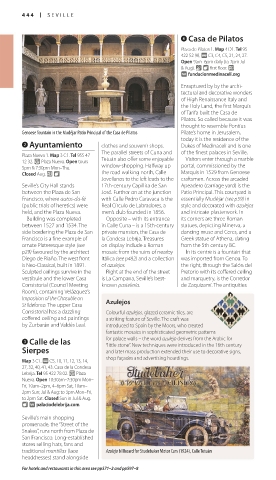
Genoese fountain in the Mudéjar Patio Principal of the Casa de Pilatos Pilate’s home in Jerusalem,
today it is the residence of the
2 Ayuntamiento clothes and souvenir shops. Dukes of Medinaceli and is one
The parallel streets of Cuna and of the finest palaces in Seville.
Plaza Nueva 1. Map 3 C1. Tel 955 47
12 32. v Plaza Nueva. Open tours Tetuán also offer some enjoyable Visitors enter through a marble
5pm & 7:30pm Mon–Thu. window-shopping. Halfway up portal, commissioned by the
Closed Aug. ^ 8 the road walking north, Calle Marquis in 1529 from Genoese
Jovellanos to the left leads to the craftsmen. Across the arcaded
Seville’s City Hall stands 17th-century Capillita de San Apeadero (carriage yard) is the
between the Plaza de San José. Further on at the junction Patio Principal. This courtyard is
Francisco, where autos-da-fé with Calle Pedro Caravaca is the essentially Mudéjar (see p59) in
(public trials of heretics) were Real Círculo de Labradores, a style and decorated with azulejos
held, and the Plaza Nueva. men’s club founded in 1856. and intricate plasterwork. In
Building was completed Opposite – with its entrance its corners are three Roman
between 1527 and 1534. The in Calle Cuna – is a 15th-century statues, depicting Minerva, a
side bordering the Plaza de San private mansion, the Casa de dancing muse and Ceres, and a
Francisco is a fine example of la Condesa Lebrija. Treasures Greek statue of Athena, dating
ornate Plateresque style (see on display include a Roman from the 5th century BC.
p29) favoured by the architect mosaic from the ruins of nearby In its centre is a fountain that
Diego de Riaño. The west front Itálica (see p482) and a collection was imported from Genoa. To
is Neo-Classical, built in 1891. of azulejos. the right, through the Salón del
Sculpted ceilings survive in the Right at the end of the street Pretorio with its coffered ceiling
vestibule and the lower Casa is La Campana, Seville’s best- and marquetry, is the Corredor
Consistorial (Council Meeting known pastelería. de Zaquizamí. The antiquities
Room), containing Velázquez’s
Imposition of the Chasuble on Azulejos
St Ildefonso. The upper Casa
Consistorial has a dazzling Colourful azulejos, glazed ceramic tiles, are
coffered ceiling and paintings a striking feature of Seville. The craft was
by Zurbarán and Valdés Leal. introduced to Spain by the Moors, who created
fantastic mosaics in sophisticated geometric patterns
3 Calle de las for palace walls – the word azulejo derives from the Arabic for
“little stone”. New techniques were introduced in the 16th century
Sierpes and later mass production extended their use to decorative signs,
shop façades and advertising hoardings.
Map 3 C1. @ C5, 10, 11, 12, 13, 14,
27, 32, 40, 41, 43. Casa de la Condesa
Lebrija. Tel 95 422 78 02. v Plaza
Nueva. Open 10:30am–7:30pm Mon–
Fri, 10am–2pm, 4–6pm Sat, 10am–
2pm Sun; Jul & Aug: to 3pm Mon–Fri,
to 2pm Sat. Closed Sun in Jul & Aug.
8 ∑ palaciodelebrija.com
Seville’s main shopping
promenade, the “Street of the
Snakes”, runs north from Plaza de
San Francisco. Long-established
stores selling hats, fans and
traditional mantillas (lace Azulejo billboard for Studebaker Motor Cars (1924), Calle Tetuán
headdresses) stand along side
For hotels and restaurants in this area see pp571–2 and pp597–8
444-445_EW_Spain.indd 444 26/09/17 11:55 am

