


Page 453 - (DK Eyewitness) Travel Guide - Spain
P. 453
FUR THER AFIELD 451
navigators and high-ranking 7 Universidad
officers. In 1849 it became the Calle San Fernando 4. Map 3 C3.
residence of the Dukes of Tel 954 55 11 23. Puerta de Jerez.
Monpensier and until 1893 its v Puerta de Jerez or Prado de San
grounds included what is now Sebas tian. @ C1, C2, C3, C4, 5, 21,
Parque María Luisa. Today it is 22, 25, 26, 28, 29, 30, 31, 34, 37, 38.
the presidential headquarters Open 8am–8:30pm Mon–Fri. Closed
of the Junta de Andalucía public hols. 8 (free, 11am Mon–Thu,
(the regional government). except Aug). ∑ us.es
The most striking feature of
the Palacio de San Telmo is the The former Real Fábrica de
exuberant Churrigueresque Tabacos (Royal Tobacco Factory)
portal designed by Leonardo de is now part of Seville University.
Figueroa, and completed in 1734. In the 19th century, three-
Surrounding the Ionic columns quarters of Europe’s cigars were
are allegorical figures represent- manufactured here, rolled by Baroque fountain in one of the patios
ing the Sciences and Arts. 10,000 cigarreras (female cigar- in the Universidad
Opposite is Seville’s most makers) – the inspiration for
famous hotel, the Alfonso XIII, French author Mérimée’s Carmen. watchtowers are evidence
dating from the 1920s. Non- Built in 1728–71, the factory of the importance given to
residents are welcome to visit complex is the third-largest protecting the king’s lucrative
the bar and the restaurant. build ing in Spain. The moat and tobacco monopoly.
Forestier, director of the the latter, in the Pabellón
Bois de Boulogne in Paris, the Mudéjar, the Museo de Artes
park was the leafy setting for y Costumbres Populares dis-
the 1929 Ibero-American plays traditional Andalucían
Exposition. The legacies of this folk arts. The Neo-Renaissance
extrava ganza are the Plaza de Pabellón de las Bellas Artes
España, decorated with regional houses the provincial Museo
scenes on ceramic tiles, and Arqueológico. Exhibits include
the Plaza de América, both the statues and fragments found
work of Aníbal González. On at Itálica (see p482).
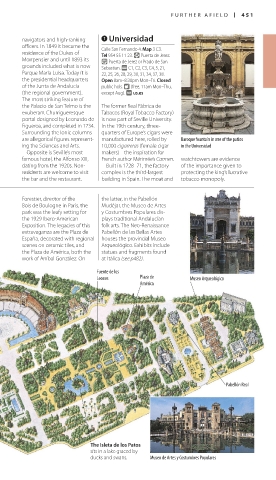
Fuente de los
Leones Plaza de Museo Arqueológico
América
Pabellón Real
The Isleta de los Patos
sits in a lake graced by
ducks and swans. Museo de Artes y Costumbres Populares
450-451_EW_Spain.indd 451 26/09/17 11:55 am

