


Page 45 - What Doctors Don't Tell You - AU-NZ (February-March 2020)
P. 45
SPECI


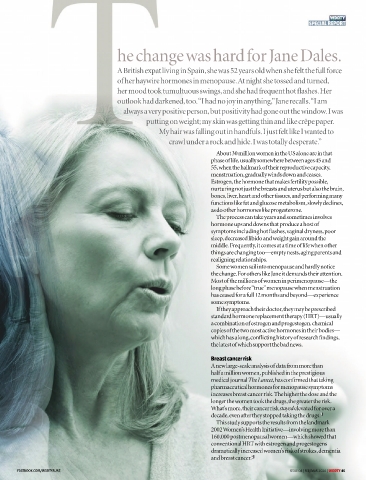
                                                     hechange was hard for Jane Dales.


                                                     ABritish expat living in Spain, she was 52 years old when she felt the full force

                                                     ofher haywire hormones in menopause. At night she tossed and turned,
                                                     hermood took tumultuous swings, and she had frequent hot flashes. Her

                                                     outlook had darkened, too. “I had no joy in anything,” Jane recalls. “I am

                                                        always a very positive person, but positivity had gone out the window. I was

                                                                  putting on weight; my skin was getting thin and like crêpe paper.

                                                                        My hair was falling out in handfuls. I just felt like I wanted to
                                                                            crawl under a rock and hide. I was totally desperate.”


                                                                                                 About 30 million women in the US alone are in that
                                                                                               phase of life, usually somewhere between ages 45 and
                                                                                               55, when the hallmark of their reproductive capacity,
                                                                                               menstruation, gradually winds down and ceases.
                                                                                               Estrogen, the hormone that makes fertility possible,
                                                                                               nurturing not just the breasts and uterus but also the brain,
                                                                                               bones, liver, heart and other tissues, and performing many
                                                                                               functions like fat and glucose metabolism, slowly declines,
                                                                                               as do other hormones like progesterone.
                                                                                                 The process can take years and sometimes involves
                                                                                               hormone ups and downs that produce a host of
                                                                                               symptoms including hot flashes, vaginal dryness, poor
                                                                                               sleep, decreased libido and weight gain around the
                                                                                               middle. Frequently, it comes at a time of life when other
                                                                                               things are changing too—empty nests, aging parents and
                                                                                               realigning relationships.
                                                                                                 Some women sail into menopause and hardly notice
                                                                                               the change. For others like Jane it demands their attention.
                                                                                               Most of the millions of women in perimenopause—the
                                                                                               long phase before “true” menopause when menstruation
                                                                                               has ceased for a full 12 months and beyond—experience
                                                                                               some symptoms.
                                                                                                 If they approach their doctor, they may be prescribed
                                                                                               standard hormone replacement therapy (HRT)—usually
                                                                                               a combination of estrogen and progestogen, chemical
                                                                                               copies of the two most active hormones in their bodies—
                                                                                               which has a long, conflicting history of research findings,
                                                                                               the latest of which support the bad news.


                                                                                               Breast cancer risk
                                                                                               A new large-scale analysis of data from more than
                                                                                               half a million women, published in the prestigious
                                                                                               medical journal The Lancet, has confirmed that taking
                                                                                               pharmaceutical hormones for menopause symptoms
                                                                                               increases breast cancer risk. The higher the dose and the
                                                                                               longer the women took the drugs, the greater the risk.
                                                                                               What’s more, their cancer risk stayed elevated for over a
                                                                                               decade, even after they stopped taking the drugs. 1
                                                                                                 This study supports the results from the landmark
                                                                                               2002 Women’s Health Initiative—involving more than
                                                                                               160,000 postmenopausal women—which showed that
                                                                                               conventional HRT with estrogen and progestogens
                                                                                               dramatically increased women’s risk of strokes, dementia
                                                                                               andbreastcancer.  2


         FACEBOOK.COM/WDDTYAUNZ                                                                                                   ISSUE 04 | FEB/MAR 2020 | WDDTY 45

