


Page 18 - All About History - Issue 70-18
P. 18
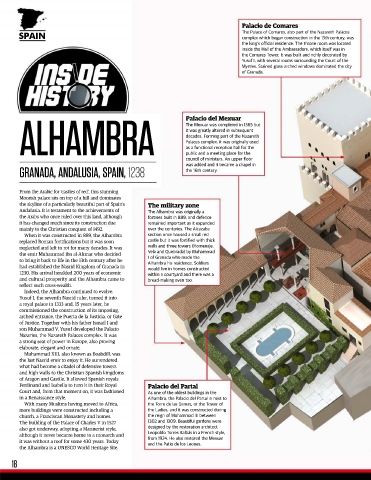
Palacio de Comares
                                                                                                                     The Palace of Comares, also part of the Nazareth Palaces
          SPAIN                                                                                                      complex which began construction in the 13th century, was
                                                                                                                     the king’s official residence. The throne room was located
                                                                                                                     inside the Hall of the Ambassadors, which itself was in
                                                                                                                     the Comares Tower. It was built and richly decorated by
                                                                                                                     Yusuf I, with several rooms surrounding the Court of the
                                                                                                                     Myrtles. Stained glass arched windows dominated the city
                                                                                                                     of Granada.


          ALHAMBRA                                                                        Palacio del Mexuar

                                                                                          The Mexuar was completed in 1365 but
                                                                                          it was greatly altered in subsequent
                                                                                          decades. Forming part of the Nazareth
                                                                                          Palaces complex, it was originally used
                                                                                          as a functional reception hall for the
                                                                                          public and a meeting place for the
                                                                                          council of ministers. An upper floor
                                                                                          was added and it became a chapel in
          GRANADA, ANDALUSIA, SPAIN, 1238                                                 the 16th century.


          From the Arabic for ‘castles  of red’, this stunning
          Moorish palace sits on top of a hill and dominates
          the skyline of a particularly beautiful part  of Spain’s      The military zone
          Andalusia. It is testament to the achievements of             The Alhambra was originally a
          the Arabs who once ruled over  this land, although            fortress built in 889, and defence
          it has changed much since its construction due                remained important as it expanded
          mainly to the Christian conquest of 1492.                     over the centuries. The Alcazaba
             When  it  was constructed in  889,  the Alhambra           section once housed a small red
          replaced Roman fortifications  but it  was soon               castle but it was fortified with thick
          neglected  and left to  rot for many  decades.  It  was       walls and three towers (Homenaje,
          the emir  Muhammad ibn al-Ahmar     who decided               Vela and Quebrada) by Muhammad
                                                                        I of Granada who made the
          to  bring it  back  to  life in  the 13th  century after he   Alhambra his residence. Soldiers
          had established the Nasrid  Kingdom of Granada in             would live in homes constructed
          1230. His arrival heralded  200 years of economic             within a courtyard and there was a
          and cultural prosperity and the Alhambra came to              bread-making oven too.
          reflect such cross-wealth.
             Indeed, the Alhambra continued to evolve.
          Yusuf I,  the seventh Nasrid  ruler,  turned  it  into
          a royal palace  in  1333 and,  15  years later,  he
          commissioned the construction of its imposing,
          arched  entrance, the Puerta  de la  Justicia, or Gate
          of Justice. Together with his father Ismail I and
          son Muhammad V, Yusuf developed the Palacio
          Nazaries, the Nazareth Palaces complex. It was
          a strong seat  of power in  Europe, also  proving
          elaborate,  elegant  and  ornate.
             Muhammad XIII, also known as Boabdill, was
          the last Nasrid emir to enjoy it. He surrendered
          what  had become a citadel of defensive towers
          and high walls to the Christian Spanish kingdoms
          of Aragon and Castile. It  allowed Spanish royals
          Ferdinand and Isabella  to  turn  it  in  their Royal         Palacio del Partal
          Court and,  from that  moment  on, it  was fashioned          As one of the oldest buildings in the
          in  a Renaissance style.                                      Alhambra, the Palacio del Partal is next to
             With many Muslims having moved to Africa,                  the Torre de las Damas, or the Tower of
          more buildings were constructed including a                   the Ladies, and it was constructed during
          church, a Franciscan Monastery and homes.                     the reign of Mohammad III between
          The building  of the Palace  of Charles V in  1527            1302 and 1309. Beautiful gardens were
          also  got underway, adopting a Mannerist style,               designed by the restoration architect
          although it  never became home to  a monarch and              Leopoldo Torres Balbás in a French style,
                                                                        from 1924. He also restored the Mexuar
          it  was without a roof for some 430 years.  Today             and the Patio de los Leones.
          the Alhambra is  a UNESCO World Heritage Site.


       18

