


Page 375 - (DK) Smithsinian - Military History: The Definitive Visual Guide to the Objects of Warfare
P. 375
373

                                                               AIRBORNE ASSAULT
                                                               OPERATION                                                                OPERA


                                                               MARKET GARDEN


                                                               Launched in September 1944, Operation Market Garden was
                                                               the largest airborne assault to date, aimed at seizing tactical
                                                               objectives in the Netherlands. It might have shortened the
                                                               war; but its successes and eventual failure showed both                  TION MARKET GARDEN
                                                               the strengths and weaknesses of airborne forces.


                                                               In August 1944, British and American  in heavy fighting, they succeeded in
                                                               airborne troops were placed under   repelling German counterattacks
                                                               unified command as the First Allied   but failed to take the vital bridge at
                                                               Airborne Army. General Bernard      Nijmegen; meanwhile a second round
                                                               Montgomery of the British Army      of airdrops and glider landings that
                                                               planned to use this force to open a   should have brought reinforcements
                                                               path through the German-occupied    was delayed by poor weather. The
                                                               Netherlands and into northern       British corps successfully made contact
                                                               Germany. Airborne troops, both      with 82nd Airborne on September 19,
                                                               parachute and glider infantry, were to  but the bridge was not taken until the
                                                               seize and hold a series of bridges and   next day, after a high-casualty river
                                                               canals to allow the British 30th Corps,  crossing by troops in rowing boats.
                                                               advancing from the Allied front line,
                                                               to move toward the German border.   BEST-LAID PLANS
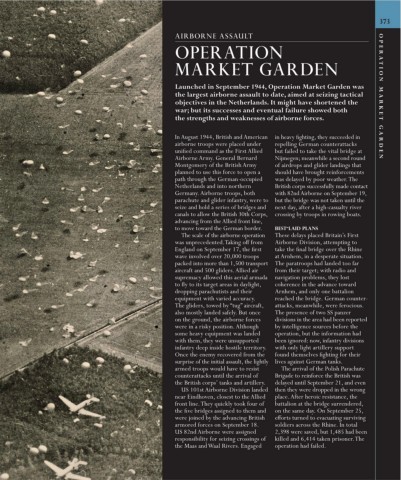
                                                                  The scale of the airborne operation   These delays placed Britain’s First
                                                               was unprecedented.Taking off from   Airborne Division, attempting to
                                                               England on September 17, the first   take the final bridge over the Rhine
                                                               wave involved over 20,000 troops    at Arnhem, in a desperate situation.
                                                               packed into more than 1,500 transport  The paratroops had landed too far
                                                               aircraft and 500 gliders. Allied air   from their target; with radio and
                                                               supremacy allowed this aerial armada  navigation problems, they lost
                                                               to fly to its target areas in daylight,   coherence in the advance toward
                                                               dropping parachutists and their     Arnhem, and only one battalion
                                                               equipment with varied accuracy.     reached the bridge. German counter-
                                                               The gliders, towed by “tug” aircraft,   attacks, meanwhile, were ferocious.
                                                               also mostly landed safely. But once    The presence of two SS panzer
                                                               on the ground, the airborne forces   divisions in the area had been reported
                                                               were in a risky position. Although   by intelligence sources before the
                                                               some heavy equipment was landed     operation, but the information had
                                                               with them, they were unsupported    been ignored: now, infantry divisions
                                                               infantry deep inside hostile territory.   with only light artillery support
                                                               Once the enemy recovered from the   found themselves fighting for their
                                                               surprise of the initial assault, the lightly  lives against German tanks.
                                                               armed troops would have to resist     The arrival of the Polish Parachute
                                                               counterattacks until the arrival of    Brigade to reinforce the British was
                                                               the British corps’ tanks and artillery.  delayed until September 21, and even
                                                                  US 101st Airborne Division landed  then they were dropped in the wrong
                                                               near Eindhoven, closest to the Allied   place. After heroic resistance, the
                                                               front line. They quickly took four of   battalion at the bridge surrendered,
                                                               the five bridges assigned to them and   on the same day. On September 25,
                                                               were joined by the advancing British   efforts turned to evacuating surviving
                                                               armored forces on September 18.     soldiers across the Rhine. In total
                                                               US 82nd Airborne were assigned      2,398 were saved, but 1,485 had been
                                                               responsibility for seizing crossings of   killed and 6,414 taken prisoner. The
                                                               the Maas and Waal Rivers. Engaged    operation had failed.

