


Page 109 - (DK Eyewitness) Travel Guide - India
P. 109
HAR Y ANA & PUNJAB 107
here that the severed head of
the ninth guru, Tegh Bahadur,
was brought to be cremated,
at a site now marked by the
Sisganj Sahib Gurdwara. The
gurdwara also marks the place
where the tenth and last guru,
Gobind Singh, founded the
Khalsa, or “Army of the Pure”, in
1699, along with five volunteers
to help him defend the faith.
The Kesgarh Sahib Gurdwara,
which was built to commem-
orate this event, is regarded as
one of the five takhts or principal
Rauza Sharif, Sahaikh Ahmad Faruqi Sirhindi’s dargah in Sirhind seats of the Sikh religion – the
others are at Amritsar (see pp108–
Mahal, whose walls still have Sharif, it is considered as holy 109), Nanded in Maharashtra,
traces of the original tilework as the Dargah Sharif in Ajmer Talwandi Sabo in Punjab and
and decorative plaster. (see p380). Standing close to Patna (see p218) in Bihar.
To the north of Aam Khas it is a striking tomb from A week-long celebration
Bagh is the white Fatehgarh the same period, the was held here in 1999,
Sahib Gurdwara, standing Mausoleum of Mir to mark the 300th anni-
in the midst of bright yellow Miran, son-in-law of one versary of the Khalsa.
mustard fields, which bloom of the Lodi kings. Also of A series of forts
in January. It was built to interest is the Salavat Beg surround Anandpur Sahib
honour the memory of the Haveli, a fascinating on all sides – Lohagarh
martyred sons of the tenth and exceptionally Fort was used as the
Sikh guru, Gobind Singh, who well-preserved armoury of the
were walled in alive at this example of a large A Nihang Sikh in Khalsa army, while
spot by the Mughal emperor Mughal-era house. full regalia Fatehgarh Fort guarded
Aurangzeb in 1705, for the route between Delhi
refusing to convert to Islam. P Aam Khas Bagh and Lahore, and Taragarh Fort
Adjacent to the gurdwara is Open Tue–Sun. protected it from attacks by the
an important pilgrimage site hill states lying to the north.
for Muslims, the tomb-shrine Anandpur Sahib comes to
of the Sufi saint and theo logian, 6 Anandpur Sahib life every year during the Hola
Shaikh Ahmad Faruqi Sirhindi, Roopnagar district. 73 km (45 miles) Mohalla festival (see p105),
who is also known as Mujaddad- NW of Chandigarh. * 16,000. £ @ when thousands of devotees
al-Saini (“The Reformer of the _ Hola Mohalla (Mar/Apr). congregate here to watch
Millennium”). This magnificent the blue-robed Nihang Sikhs,
octagonal structure, with its Guarded by the Shivalik Hills descendants of the gurus’
dome covered in glazed blue and a ring of imposing forts, personal guards, display their
tiles, was built in the 16th Anandpur Sahib is a complex of formidable martial and
century. Known as the Rauza historic Sikh gurdwaras. It was equestrian skills.
Sikhism
With their characteristic turbans and full beards, Sikh men are
easy to identify. The Sikh religion is a reformist faith, founded by Guru
Nanak in the 15th century. Strongly opposed to idol worship, rituals
and the caste system, it believes in a formless God. Sikhism is also
called the Gurmat, meaning “the Guru’s Doctrine”, and Sikh temples
are known as gurdwaras, literally “doors to the guru”. Nanak, the first
of a series of ten gurus, chose his successor from among his most
devout disciples. Gobind Singh (1666–1708), the tenth and last guru,
reorganized the community in 1699 as a military order, the Khalsa, to
combat religious persecution by the Mughals. He gave the Sikh
community a distinctive religious identity, and from then onwards
they were meant to wear the Khalsa’s five symbols: kesh (long hair),
kachha (underwear), kirpan (small sword), kangha (comb) and kara
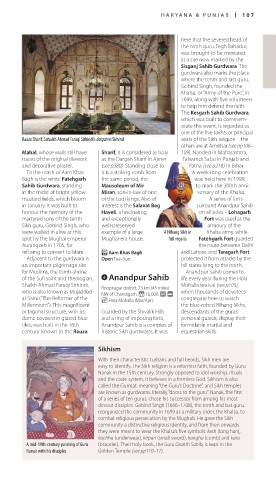
A mid-19th-century painting of Guru (bracelet). Their holy book, the Guru Granth Sahib, is kept in the
Nanak with his disciples Golden Temple (see pp110–11).
106-107_EW_India.indd 107 26/04/17 11:43 am

