


Page 252 - (DK Eyewitness) Travel Guide - India
P. 252
250 CENTR AL INDIA
e Indore
Indore district. 187 km (116 miles) SW
of Bhopal. * 1,597,400. ~ 10 km
(6 miles) W of town. £ @ n Tourist
Reception Centre (MP Tourism), 42
Residency Area, opposite St Paul High
School, (0731) 249 9566. ( Mon–Sat.
_ Ganesha Chaturthi (Aug/Sep).
The bustling commercial centre
of Madhya Pradesh, until 1947
Indore was a princely state,
ruled by the Maratha Holkar
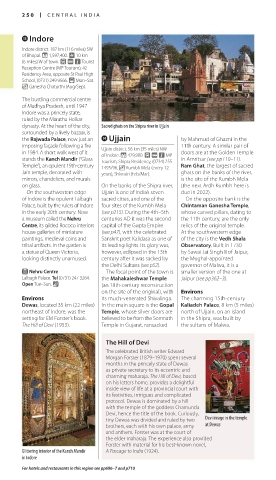
dynasty. At the heart of the city, Sacred ghats on the Shipra river in Ujjain
surrounded by a lively bazaar, is
the Rajwada Palace, now just an r Ujjain by Mahmud of Ghazni in the
imposing façade following a fire Ujjain district. 56 km (35 miles) NW 11th century. A similar pair of
in 1984. A short walk west of it of Indore. * 429,900. £ @ n MP doors are at the Golden Temple
stands the Kanch Mandir (“Glass Tourism, Shipra Residency, (0734) 255 in Amritsar (see pp110–11).
Temple”), an opulent 19th-century 1495/96. _ Kumbh Mela (every 12 Ram Ghat, the largest of sacred
Jain temple, decorated with years), Shivratri (Feb/Mar). ghats on the banks of the river,
mirrors, chandeliers, and murals is the site of the Kumbh Mela
on glass. On the banks of the Shipra river, (the next Ardh Kumbh here is
On the southwestern edge Ujjain is one of India’s seven due in 2022).
of Indore is the opulent Lalbagh sacred cities, and one of the On the opposite bank is the
Palace, built by the rulers of Indore four sites of the Kumbh Mela Chintaman Ganesha Temple,
in the early 20th century. Now (see p215). During the 4th–5th whose carved pillars, dating to
a museum called the Nehru centuries AD it was the second the 11th century, are the only
Centre, its gilded Rococo interiors capital of the Gupta Empire relics of the original temple.
house galleries of miniature (see p47), with the celebrated At the southwestern edge
paintings, medieval coins and Sanskrit poet Kalidasa as one of of the city is the Vedh Shala
tribal artifacts. In the garden is its leading lights. Its glory was, Observatory. Built in 1730
a statue of Queen Victoria, however, eclipsed in the 13th by Sawai Jai Singh II of Jaipur,
looking distinctly unamused. century after it was sacked by the Mughal-appointed
the Delhi Sultans (see p52). governor of Malwa, it is a
E Nehru Centre The focal point of the town is smaller version of the one at
Lalbagh Palace. Tel (0731) 247 3264. the Mahakaleshwar Temple Jaipur (see pp362–3).
Open Tue–Sun. & (an 18th-century reconstruction
on the site of the original), with Environs
Environs its much-venerated Shivalinga. The charming 15th-century
Dewas, located 35 km (22 miles) In the main square is the Gopal Kaliadeh Palace, 8 km (5 miles)
northeast of Indore, was the Temple, whose silver doors are north of Ujjain, on an island
setting for EM Forster’s book. believed to be from the Somnath in the Shipra, was built by
The Hill of Devi (1953). Temple in Gujarat, ransacked the sultans of Malwa.
The Hill of Devi
The celebrated British writer Edward
Morgan Forster (1879–1970) spent several
months in the princely state of Dewas
as private secretary to its eccentric and
charming maharaja. The Hill of Devi, based
on his letters home, provides a delightful
inside view of life at a provincial court with
its festivities, intrigues and complicated
protocol. Dewas is dominated by a hill
with the temple of the goddess Chamunda
Devi, hence the title of the book. Curiously,
tiny Dewas was divided and ruled by two Devi image in the temple
brothers, each with his own palace, army at Dewas
and anthem. Forster was at the court of
the elder maharaja. The experience also provided
Forster with material for his best-known novel,
Glittering interior of the Kanch Mandir A Passage to India (1924).
in Indore
For hotels and restaurants in this region see pp696–7 and p710
250-251_EW_India.indd 250 26/04/17 11:44 am
Eyewitness Travel LAYERS PRINTED:
Catalogue template “UK” LAYER
(Source v2.6)
Date 12th July 2013
Size 125mm x 217mm

