


Page 286 - (DK Eyewitness) Travel Guide - India
P. 286
284 EASTERN INDIA
chandeliers, Ming vases and Jorasanko is the ancestral
Egyptian statuary that he housed home of Bengal’s favourite son,
in his Classical-fronted mansion, Rabindranath Tagore (see p296).
built around a colonnaded Built in 1785, this simple three-
courtyard. Today, the Marble storeyed, red-brick structure
Palace provides a wonderful housed the lively and cultivated
glimpse into the life of a rich Tagore family, many members
19th-century Bengali household. of which were prominent
Nearly a 100 vari eties of marble intellectuals and social reformers.
have been used on the floors The lane on which the house
and the dark halls are hung with is located is named after
paintings by European artists. Dwarkanath Tagore (1794–
In the courtyard is the family 1846), the poet’s father and
temple, while the grounds have a wealthy entrepreneur.
a rock garden and aviary, home Today, the old house has
to mynahs and peacocks. been expanded and turned into
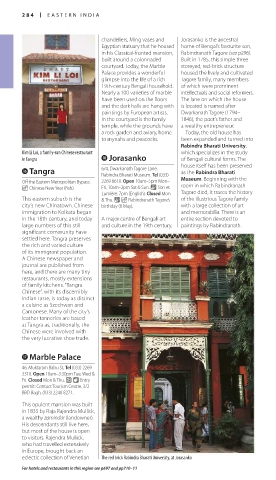
Rabindra Bharati University,
Kim Li Loi, a family-run Chinese restaurant which specializes in the study
in Tangra i Jorasanko of Bengali cultural forms. The
house itself has been preserved
y Tangra 6/4, Dwarkanath Tagore Lane. as the Rabindra Bharati
Rabindra Bharati Museum: Tel (033)
Off the Eastern Metropolitan Bypass. 2269 6610. Open 10am–5pm Mon– Museum. Beginning with the
_ Chinese New Year (Feb). Fri, 10am–2pm Sat & Sun. & Son et room in which Rabindranath
Lumière: 7pm (English). Closed Mon Tagore died, it traces the history
This eastern suburb is the & Thu. & _ Rabindranath Tagore’s of the illustrious Tagore family
city’s new Chinatown. Chinese birthday (8 May). with a large collection of art
immigration to Kolkata began and memorabilia. There is an
in the 18th century, and today A major centre of Bengali art entire section devoted to
large numbers of this still and culture in the 19th century, paintings by Rabindranath.
signif icant community have
settled here. Tangra preserves
the rich and varied culture
of its immigrant population.
A Chinese newspaper and
journal are published from
here, and there are many tiny
restaurants, mostly extensions
of family kitchens. “Tangra
Chinese’’, with its discernibly
Indian taste, is today as distinct
a cuisine as Szechwan and
Cantonese. Many of the city’s
leather tanneries are based
at Tangra as, traditionally, the
Chinese were involved with
the very lucrative shoe trade.
u Marble Palace
46, Muktaram Babu St. Tel (033) 2269
3310. Open 10am–3:30pm Tue, Wed &
Fri. Closed Mon & Thu. ^ 8 Entry
permit: Contact Tourism Centre, 3/2
BBD Bagh, (033) 2248 8271.
This opulent mansion was built
in 1835 by Raja Rajendra Mullick,
a wealthy zamindar (landowner).
His descendants still live here,
but most of the house is open
to visitors. Rajendra Mullick,
who had travelled extensively
in Europe, brought back an
eclectic collection of Venetian The red brick Rabindra Bharati University, at Jorasanko
For hotels and restaurants in this region see p697 and pp710–11
284-285_EW_India.indd 284 26/04/17 11:54 am

