


Page 99 - (DK Eyewitness) Travel Guide: Japan
P. 99
WESTERN T OK Y O 97
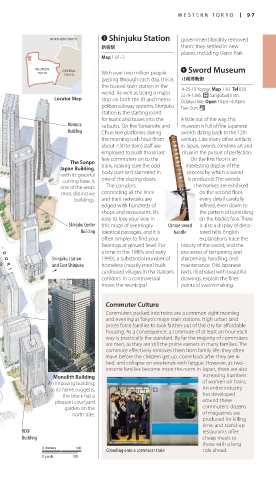
3 Shinjuku Station
NORTHERN TOKYO government forcibly removed
them; they settled in new
Shinjuku Station
places, including Ueno Park.
Map 1 B1–2.
WESTERN 4 Sword Museum
TOKYO CENTRAL With over two million people
TOKYO
passing through each day, this is Sword Museum
the busiest train station in the 4-25-10 Yoyogi. Map 1 A3. Tel (03)
world. As well as being a major 3379-1386. £ Sangubashi stn,
Locator Map stop on both the JR and metro- Odakyu line. Open 10am–4:30pm
politan subway systems, Shinjuku Tue–Sun. &
station is the starting point
for trains and buses into the A little out of the way, this
Nomura suburbs. On the Yamanote and museum is full of fine Japanese
Building Chuo line platforms during swords dating back to the 12th
the morning rush hour (from century. Like many other artifacts
about 7:30 to 9am) staff are in Japan, swords combine art and
employed to push those last ritual in the pursuit of perfection.
few commuters on to the On the first floor is an
The Sonpo
Japan Building, train, making sure the odd interesting display of the
with its graceful body part isn’t slammed in process by which a sword
curving base, is one of the closing doors. is produced. The swords
one of the area’s The corridors themselves are exhib ited
most distinctive connecting all the lines on the second floor,
buildings. and train networks are every detail carefully
H
edged with hundreds of refined, even down to
I
shops and restaurants. It’s the pattern of burnishing
G
easy to lose your way in on the blade’s face. There
A
Shinjuku Center this maze of seemingly Ornate sword is also a display of deco-
S
H
Building
I identical passages, and it is handle rated hilts. English
often simpler to find your explanations trace the
bearings at ground level. For history of the sword, and the
–
a time in the 1980s and early processes of tempering and
D
Shinjuku station 1990s, a substantial number of sharpening, handling, and
O
and East Shinjuku home less (mostly men) built maintenance. Old Japanese
R
card board villages in the station’s texts, illustrated with beautiful
I
corridors. In a controversial drawings, explain the finer
move, the municipal points of sword-making.
Commuter Culture
Commuters packed into trains are a common sight morning
and evening at Tokyo’s major train stations. High urban land
prices force families to look farther out of the city for affordable
housing. As a consequence, a commute of at least an hour each
way is practically the standard. By far the majority of commuters
are men, as they are still the prime earners in many families. The
commute effectively removes them from family life: they often
leave before the children get up, come back after they are in
bed, and collapse on weekends with fatigue. However, as two-
income families become more the norm in Japan, there are also
Monolith Building increasing numbers
An imposing building, of women on trains.
as its name suggests, An entire industry
this block has a has developed
pleasant courtyard around these
garden on the commuters: dozens
north side. of magazines are
produced for killing
time, and stand-up
KDDI restaurants offer
Building cheap meals to
those with a long
0 meters 100 Crowding onto a commuter train ride ahead.
0 yards 100
096-097_EW_Japan.indd 97 08/08/16 4:04 pm

