


Page 37 - Forbes - Asia (June 2018)
P. 37
sell his remaining silk stock. “Someone had just let his company,”   kets and added more complex printing technology. Still, the
           recalls Bill. “He said, ‘You speak some hai, and you know silk.’ He   company occupies just a tiny niche in the world silk market.
           hired me on the spot.” When he mentions the date, we both laugh.   China has dominated the silk trade for centuries. Bill estimates
           It was April 1—April Fools’ Day.                  that 90% of production comes from China, with India adding
             He says their styles were completely diferent. “I saw Jim every   5%. “hailand silk may account for 1%,” he says. “hat’s why
           day. It was a small company then, probably 50 people, and only a   what we are doing now is so important. We really have to move
           few foreigners,” he says. “Jim was high up there; he knew royalty,   up, position ourselves at the luxury level. hat’s the only way to
           everyone. I was in a totally diferent crowd, you know, the sports   succeed outside of hailand.”
           club.” In reality, though, it’s hard to imagine a boss who would be a   he company markets the unique feel of hailand’s silk and
           better steward for hompson’s vision. “All the time,” he concedes,   its handcrated products. “What Jim discovered in the 1940s was
           “we think: ‘What would Jim do?’ ”                 that silk in the markets here was diferent from silk available from
             From the start, hompson was one of hailand’s biggest boost-  China and Japan,” says Eric. “It was also hand-reeled, handwoven
           ers, promoting tourism and supporting community charities.   and hand-dyed. And uneven. hat gave it this unique texture.”
           And, of course, hai Silk would thrive if hailand thrived. Today   Long ago the market moved to mass production and consistency,
           tourists visit the Jim hompson House and watch cocoons being   but these days there is more interest in artisanal products, he adds.
           turned into the silk that’s woven into products they can buy at the   “hat’s our advantage.”
           showroom on-site. hen they can dine at a hai restaurant—there   In ive years, he says, the company will add stores in Paris,
           are six Jim hompson food outlets in hailand and one in Singa-  London, Hong Kong, Singapore and Shanghai. A New York
           pore. Two more are franchise operations in Japan.   store opened late last year to cater to the wholesale trade, largely
             Upstairs is an art gallery, itting since hompson was a pas-  architects and interior designers. Eric travels regularly and has
           sionate collector of art and antiques from across Southeast Asia.   ramped up the wholesale business, supplying fabric to designers
           Yet these are contemporary works. Credit Eric, who walked me   and distributing in department stores. And Jim hompson restau-
           through the gallery. He’s been collecting art since
           1992 and has between 250 and 300 pieces, he says.
           Collecting runs in the family: His hai mother, the
           late Patsri Bunnag, was a notable fashion collec-
           tor, and ater his parents separated, she married
           French art collector Jean Michel Beurdeley. “It’s an
           addiction,” says Eric, smiling, “but a good addic-
           tion.” Two years ago, Eric and Beurdeley opened
           Maiiam Contemporary Art Museum in Chiang
           Mai. Besides works from the family collection,
           the museum hosts hai exhibits that are oten
           provocative and address pressing concerns.
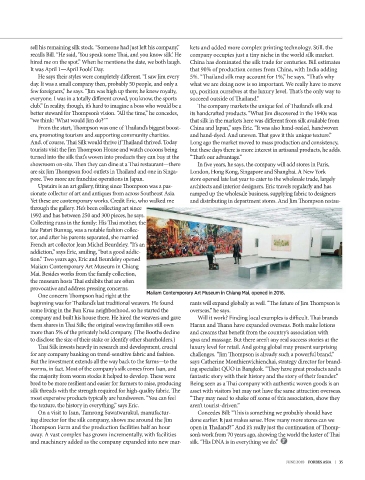
                                               Maiiam Contemporary Art Museum in Chiang Mai, opened in 2016.
             One concern hompson had right at the
           beginning was for hailand’s last traditional weavers. He found   rants will expand globally as well. “he future of Jim hompson is
           some living in the Ban Krua neighborhood, so he started the   overseas,” he says.
           company and built his house there. He hired the weavers and gave   Will it work? Finding local examples is diicult. hai brands
           them shares in hai Silk; the original weaving families still own   Harnn and hann have expanded overseas. Both make lotions
           more than 5% of the privately held company. (he Booths decline   and creams that beneit from the country’s association with
           to disclose the size of their stake or identify other shareholders.)  spas and massage. But there aren’t any real success stories at the
             hai Silk invests heavily in research and development, crucial   luxury level for retail. And going global may present surprising
           for any company banking on trend-sensitive fabric and fashion.   challenges. “Jim hompson is already such a powerful brand,”
           But the investment extends all the way back to the farms—to the   says Catherine Monthienvichienchai, strategy director for brand-
           worms, in fact. Most of the company’s silk comes from Isan, and   ing specialist QUO in Bangkok. “hey have great products and a
           the majority from worm stocks it helped to develop. hese were   fantastic story with their history and the story of their founder.”
           bred to be more resilient and easier for farmers to raise, producing   Being seen as a hai company with authentic woven goods is an
           silk threads with the strength required for high-quality fabric. he   asset with visitors but may not have the same attraction overseas.
           most expensive products typically are handwoven. “You can feel   “hey may need to shake of some of this association, show they
           the texture, the history in everything,” says Eric.    aren’t tourist-driven.”
             On a visit to Isan, Tamrong Sawatwarakul, manufactur-  Concedes Bill: “his is something we probably should have
           ing director for the silk company, shows me around the Jim   done earlier. It just makes sense. How many more stores can we
           hompson Farm and the production facilities half an hour   open in hailand?” And it’s really just the continuation of homp-
           away. A vast complex has grown incrementally, with facilities   son’s work from 70 years ago, showing the world the luster of hai
           and machinery added as the company expanded into new mar-  silk. “His DNA is in everything we do.” F


                                                                                           JUNE 2018     FORBES ASIA     |     35

