


Page 74 - Forbes - Asia (June 2018)
P. 74
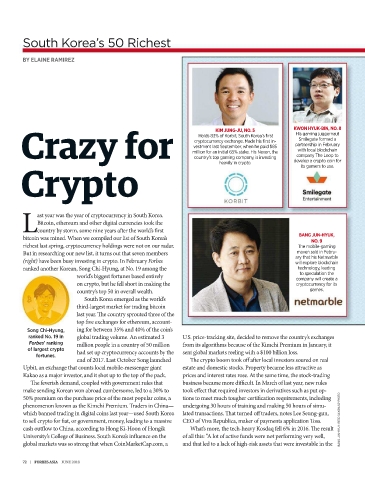
South Korea’s 50 Richest


        BY ELAINE RAMIREZ


                                                                     KIM JUNG-JU, NO. 5       KWON HYUK-BIN, NO. 8
        Crazy for                                             million for an initial 65% stake. His Nexon, the   partnership in February
                                                                                              His gaming juggernaut
                                                                Holds 83% of Korbit, South Korea’s fi rst
                                                                                               Smilegate formed a
                                                              cryptocurrency exchange. Made his fi rst in-
                                                              vestment last September, when he paid $85
                                                                                               with local blockchain
                                                                                               company The Loop to
                                                              country’s top gaming company, is investing
                                                                      heavily in crypto.      develop a crypto coin for
                                                                                                its gamers to use.
        Crypto


             ast year was the year of cryptocurrency in South Korea.
             Bitcoin, ethereum and other digital currencies took the
        Lcountry by storm, some nine years at er the world’s i rst
                                                                                               BANG JUN-HYUK,
        bitcoin was mined. When we compiled our list of South Korea’s
                                                                                                   NO. 9
        richest last spring, cryptocurrency holdings were not on our radar.                    The mobile-gaming
        But in researching our new list, it turns out that seven members                       maven said in Febru-
                                                                                              ary that his Netmarble
        (right) have been busy investing in crypto. In February  Forbes                       will explore blockchain
        ranked another Korean, Song Chi-Hyung, at No. 19 among the                             technology, leading
                                                                                                to speculation the
                         world’s biggest fortunes based entirely
                                                                                              company will create a
                         on crypto, but he fell short in making the                            cryptocurrency for its
                         country’s top 50 in overall wealth.                                       games.
                            South Korea emerged as the world’s
                         third-largest market for trading bitcoin

                         last year. he country sprouted three of the

                         top ive exchanges for ethereum, account-
          Song Chi-Hyung,   ing for between 35% and 40% of the coin’s
          ranked No. 19 in   global trading volume. An estimated 3   U.S. price-tracking site, decided to remove the country’s exchanges
          Forbes’ ranking   million people in a country of 50 million   from its algorithms because of the Kimchi Premium in January, it
          of largest crypto   had set up cryptocurrency accounts by the   sent global markets reeling with a $100 billion loss.
            fortunes.


                         end of 2017. Last October Song launched   he crypto boom took of  ater local investors soured on real
        Upbit, an exchange that counts local mobile-messenger giant   estate and domestic stocks. Property became less attractive as
        Kakao as a major investor, and it shot up to the top of the pack.   prices and interest rates rose. At the same time, the stock-trading


           he feverish demand, coupled with government rules that   business became more diicult. In March of last year, new rules
        make sending Korean won abroad cumbersome, led to a 30% to   took efect that required investors in derivatives such as put op-

        50% premium on the purchase price of the most popular coins, a   tions to meet much tougher certiication requirements, including

        phenomenon known as the Kimchi Premium. Traders in China—  undergoing 30 hours of training and making 50 hours of simu-
        which banned trading in digital coins last year—used South Korea   lated transactions. hat turned of traders, notes Lee Seung-gun,


        to sell crypto for iat, or government, money, leading to a massive   CEO of Viva Republica, maker of payments application Toss.   BANG JUN-HYUK: REED SAXON/AP PHOTO

                                                                                                     e
        cash outlow to China, according to Hong Ki-Hoon of Hongik   What’s more, the tech-heavy Kosdaq fell 6% in 2016. h result
        University’s College of Business. South Korea’s inluence on the   of all this: “A lot of active funds were not performing very well,

        global markets was so strong that when CoinMarketCap.com, a   and that led to a lack of high-risk assets that were investable in the
        72     |     FORBES ASIA     JUNE 2018

