


Page 70 - All About History - Issue 59-17
P. 70
Tang Dynasty China


          Wu had two sons with Gaozong but that fact
        alone would not have worried Wang and Xiao.
        The emperor had already chosen a successor — his
        chancellor was his wife’s uncle, and he had named
        his son, Li Zhong, as his current heir. However, Wu
        had another baby in 654, a girl, who was found
        dead in her crib just days after being born.
          This is where the historical narratives split. For
        Wu, the culprit was clear — Wang had been jealous
        of her husband’s affections for her and of her
        ability to bear him children for some time, and she
        had taken it out on her newborn baby. Wang was
        the last person seen in the room and had no alibi.
        Wu claimed that Wang had strangled her child
        and was also practicing witchcraft, along with
        Xiao. The charges were taken very seriously and
        the emperor sided with Wu over his wife. Wang
        and Xiao were exiled from the palace, Li Zhong
        stripped of his position as heir and Wu given the
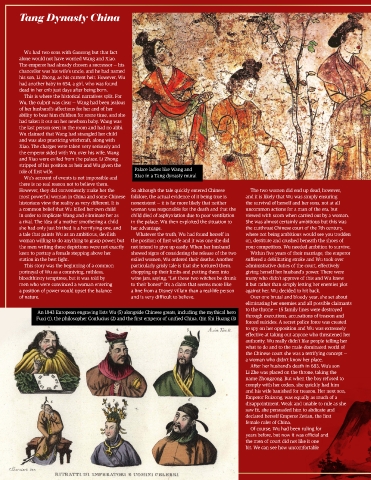
        role of first wife.                     Palace ladies like Wang and
          Wu’s account of events is not impossible and   Xiao in a Tang dynasty mural
        there is no real reason not to believe them.
        However, they did conveniently make her the   So although the tale quickly entered Chinese   The two women did end up dead, however,
        most powerful woman in China and some Chinese   folklore, the actual evidence of it being true is   and it is likely that Wu was simply ensuring
        historians view the reality as very different. It is   nonexistent — it is far more likely that neither   the survival of herself and her sons, not at all
        a common belief that Wu killed her own child   woman was responsible for the death and that the   uncommon actions for a man of the era, but
        in order to implicate Wang and eliminate her as   child died of asphyxiation due to poor ventilation   viewed with scorn when carried out by a woman.
        a rival. The idea of a mother smothering a child   in the palace. Wu then exploited the situation to   She was almost certainly ambitious but this was
        she had only just birthed is a horrifying one, and   her advantage.            the cutthroat Chinese court of the 7th century,
        a tale that paints Wu as an ambitious, devilish   Whatever the truth, Wu had found herself in   where not being ambitious would see you trodden
        woman willing to do anything to grasp power, but   the position of first wife and it was one she did   on, destitute and crushed beneath the shoes of
        the men writing these depictions were not exactly   not intend to give up easily. When her husband   your competitors. Wu needed ambition to survive.
        keen to portray a female stepping above her   showed signs of considering the release of the two   Within five years of their marriage, the emperor
        station in the best light.             exiled women, Wu ordered their deaths. Another   suffered a debilitating stroke and Wu took over
          This story was the beginning of a common   particularly grisly tale is that she tortured them,   administrative duties of the court, effectively
        portrayal of Wu as a conniving, ruthless,   chopping up their limbs and putting them into   giving herself her husband’s power. There were
        bloodthirsty temptress, but it was told by    wine jars, saying, “Let these two witches be drunk   many who didn’t approve of this and Wu knew
        men who were convinced a woman entering    to their bones!” It’s a claim that seems more like   it but rather than simply letting her enemies plot
        a position of power would upset the balance    a line from a Disney villain than a real-life person   against her, Wu decided to hit back.
        of nature.                             and is very difficult to believe.         Over one brutal and bloody year, she set about
                                                                                       eliminating her enemies and all possible claimants
                                                                                       to the throne — 15 family lines were destroyed
              An 1843 European engraving lists Wu (5) alongside Chinese greats, including the mythical hero
              Fuxi (1), the philosopher Confucius (2) and the first emperor of unified China, Qin Shi Huang (3)   through executions, accusations of treason and
                                                                                       forced suicides. A secret police force was created
                                                                                       to spy on her opposition and Wu was extremely
                                                                                       effective at taking out anyone who threatened her
                                                                                       authority. Wu really didn’t like people telling her
                                                                                       what to do and to the male-dominated world of
                                                                                       the Chinese court she was a terrifying concept —
                                                                                       a woman who didn’t know her place.
                                                                                         After her husband’s death in 683, Wu’s son
                                                                                       Li Zhe was placed on the throne, taking the
                                                                                       name Zhongzong. But when the boy refused to
                                                                                       comply with her orders, she quickly had him
                                                                                       and his wife banished for treason. Her next son,
                                                                                       Emperor Ruizong, was equally as much of a
                                                                                       disappointment. Weak and unable to rule as she
                                                                                       saw fit, she persuaded him to abdicate and
                                                                                       declared herself Emperor Zetian, the first
                                                                                       female ruler of China.
                                                                                         Of course, Wu had been ruling for
                                                                                       years before, but now it was official and
                                                                                       the men of court did not like it one
                                                                                       bit. We can see how uncomfortable

     70

