


Page 77 - All About History - Issue 59-17
P. 77
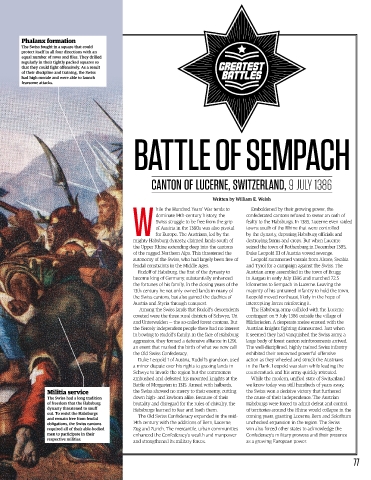
Phalanx formation
         The Swiss fought in a square that could
         protect itself in all four directions with an
         equal number of rows and files. They drilled
         regularly in their tightly packed squares so
         that they could fight offensively. As a result
         of their discipline and training, the Swiss
         had high morale and were able to launch
         fearsome attacks.


                                                Battle of Sempach


                                                      canton of lucerne, SWitzerland, 9 July 1386


                                                                            Written by William E. Welsh
                                                        hile the Hundred Years’ War tends to   Emboldened by their growing power, the
                                                        dominate 14th-century history, the   confederated cantons refused to swear an oath of
                                                        Swiss struggle to be free from the grip   fealty to the Habsburgs. In 1385, Lucerne even raided
                                                        of Austria in the 1380s was also pivotal   towns south of the Rhine that were controlled
                                               W for Europe. The Austrians, led by the   by the dynasty, deposing Habsburg officials and
                                                mighty Habsburg dynasty, claimed lands south of   destroying farms and crops. But when Lucerne
                                                the Upper Rhine extending deep into the cantons   seized the town of Rothenburg in December 1385,
                                                of the rugged Northern Alps. This threatened the   Duke Leopold III of Austria vowed revenge.
                                                autonomy of the Swiss, who had largely been free of   Leopold summoned vassals from Alsace, Swabia
                                                feudal constraints in the Middle Ages.  and Tyrol for a campaign against the Swiss. The
                                                  Rudolf of Habsburg, the first of the dynasty to   Austrian army assembled in the town of Brugg
                                                become king of Germany, substantially enhanced   in Aargau in early July 1386 and marched 72.5
                                                the fortunes of his family. In the closing years of the   kilometres to Sempach in Lucerne. Leaving the
                                                13th century he not only owned lands in many of   majority of his untrained infantry to hold the town,
                                                the Swiss cantons, but also gained the duchies of   Leopold moved northeast, likely in the hope of
                                                Austria and Styria through conquest.    intercepting forces reinforcing it.
                                                   Among the Swiss lands that Rudolf’s descendents   The Habsburg army collided with the Lucerne
                                                coveted were the three rural districts of Schwyz, Uri   contingent on 9 July 1386 outside the village of
                                                and Unterwalden — the so-called forest cantons. But   Hildisrieden. A desperate melee ensued with the
                                                the fiercely independent people there had no interest   Austrian knights fighting dismounted. Just when
                                                in bowing to Rudolf’s family. In the face of Habsburg   it seemed they had vanquished the Swiss army, a
                                                aggression, they formed a defensive alliance in 1291,   large body of forest canton reinforcements arrived.
                                                an event that marked the birth of what we now call   The well-disciplined, highly trained Swiss infantry
                                                the Old Swiss Confederacy.              exhibited their renowned powerful offensive
                                                  Duke Leopold I of Austria, Rudolf’s grandson, used   action as they wheeled and struck the Austrians
                                                a minor dispute over his rights to grazing lands in   in the flank. Leopold was slain while leading the
                                                Schwyz to invade the region but the commoners   counterattack and his army quickly retreated.
                                                ambushed and defeated his mounted knights at the   While the modern, unified state of Switzerland
                                                Battle of Morgarten in 1315. Armed with halberds,   we know today was still hundreds of years away,
                  Militia service               the Swiss showed no mercy to their enemy, cutting   the Swiss won a decisive victory that furthered
                  The Swiss had a long tradition   down high- and lowborn alike. Because of their   the cause of their independence. The Austrian
                  of freedom that the Habsburg   brutality and disregard for the rules of chivalry, the   Habsburgs were forced to admit defeat and control
                  dynasty threatened to snuff   Habsburgs learned to fear and loath them.  of territories around the Rhine would collapse in the
                  out. To resist the Habsburgs    The Old Swiss Confederacy expanded in the mid-  coming years, granting Lucerne, Bern and Solothurn
                  and remain free from feudal
                  obligations, the Swiss cantons   14th century with the additions of Bern, Lucerne,   unchecked expansion in the region. The Swiss
                  required all of their able-bodied   Zug and Zurich. The mercantile, urban communities   win also forced other states to acknowledge the
                  men to participate in their   enhanced the Confederacy’s wealth and manpower   Confederacy’s military prowess and their presence
                  respective militias.
                                                and strengthened its military forces.   as a growing European power.

                                                                                                                             77

