


Page 241 - (DK) The Business Book
P. 241
SUCCESSFUL SELLING         239


                                         most important in the marketing   Marketers have developed new
                                         environment. These encompass     strategies for online information
                                         gender, life stage, income, trends,   gathering, such as personalized,
                                         current issues, and the influence of   or one-on-one, marketing, in which
                                         key individuals in the public eye.   a single consumer’s interests
            Research is formalized          The challenge for the marketer   and wants can be recorded and
           curiosity. It is poking and   is finding out how all of these   compiled to create a detailed profile.
            prying with a purpose.       things influence customers and,      Psychographic profiling is one
            Zora Neale Hurston           consequently, what motivates them   way that marketers attempt to
           US anthropologist (1891–1960)  to buy. The obvious starting point   make sense of diverse consumer
                                         is to ask questions. This basic   interests, by corralling individuals
                                         premise developed during the 1960s   with shared interests and
                                         and 1970s into a formal process    motivations into groups that can
                                         of question-and-answer known     be targeted. Whereas businesses
                                         as market research. Researchers   used to define their customers
                                         gathered both quantitative evidence   demographically, for example as
        a wide spectrum of external factors,  (from simple questions directed   Baby Boomers or Generation X,
        so it is crucial to understand these   toward a large audience) and   a psychographic profile is much
        to get to their hearts and minds.   qualitative evidence (through direct  more detailed. It is put together
           Price cutting by competitors, for   observation or in-depth discussion   by using information about a
        example, can divide the customer’s   with a small sample of individuals).   consumer’s daily habits; favorite
        attention, providing enticement but   Qualitative research is usually   brands, music, and athletic
        also potentially damaging a brand’s   regarded as the more valuable of   personalities; media habits;
        value in the eyes of the consumer.   the two in getting a grasp of why    leisure activities; vacation
        A business therefore needs to know  a customer accepts or rejects a   destinations; and much more.
        how sensitive their existing and   product, and in understanding the   Social media and online
        potential customers are to price.   realities of customers’ lives.  communities have encouraged
           The distribution system, which                                 people to define themselves by an
        determines how products and      Personalized marketing           ever-more specific set of
        services get to potential buyers, is   Since the 1990s, business has forged  characteristics, likes and dislikes.
        also a vital aspect to consider. A   a direct path of communication   At the same time, the Internet has
        business should figure out how to   with the customer via the Internet.   allowed businesses to glean ❯❯
        deliver products and services in a
        way that best suits purchasers. The
        Internet has transformed how this
        happens, and customers now
        expect sellers to understand where,
        when, and how they want to buy.

        Types of research
        The state of the economy, level of
        interest rates, regulatory law, and
        technological change can sway
        customers, while social and
        cultural forces are arguably the


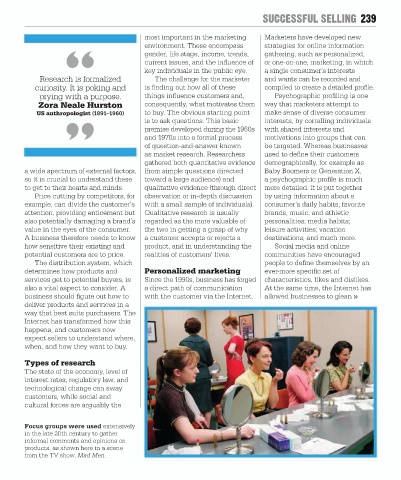
        Focus groups were used extensively
        in the late 20th century to gather
        informal comments and opinions on
        products, as shown here in a scene
        from the TV show, Mad Men.

