


Page 248 - (DK) The Business Book
P. 248
246 MARKETING MYOPIA


          IN CONTEXT
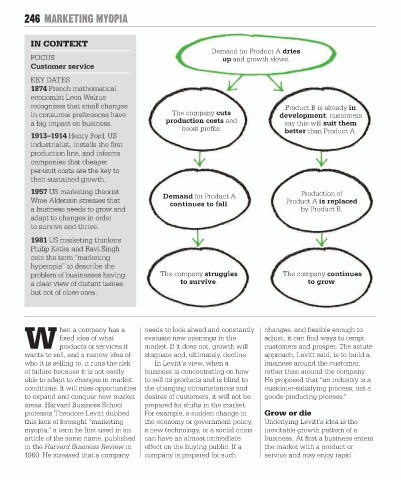
                                                           Demand for Product A dries
          FOCUS                                               up and growth slows.
          Customer service
          KEY DATES
          1874 French mathematical
          economist Leon Walrus
          recognizes that small changes                                         Product B is already in
          in consumer preferences have          The company cuts              development; customers
          a big impact on business.            production costs and             say this will suit them
                                                   boost profits.               better than Product A.
          1913–1914 Henry Ford, US
          industrialist, installs the first
          production line, and informs
          companies that cheaper
          per-unit costs are the key to
          their sustained growth.
          1957 US marketing theorist                                                Production of
                                              Demand for Product A
          Wroe Alderson stresses that                                           Product A is replaced
                                                continues to fall.
          a business needs to grow and                                              by Product B.
          adapt to changes in order
          to survive and thrive.

          1981 US marketing thinkers
          Philip Kotler and Ravi Singh
          coin the term “marketing
          hyperopia” to describe the
          problem of businesses having       The company struggles             The company continues
          a clear view of distant issues           to survive.                        to grow.
          but not of close ones.


                 hen a company has a     needs to look ahead and constantly   changes, and flexible enough to
                 fixed idea of what       evaluate new openings in the     adjust, it can find ways to tempt
        W products or services it        market. If it does not, growth will   customers and prosper. The astute
        wants to sell, and a narrow idea of   stagnate and, ultimately, decline.  approach, Levitt said, is to build a
        who it is selling to, it runs the risk   In Levitt’s view, when a   business around the customer,
        of failure because it is not easily   business is concentrating on how   rather than around the company.
        able to adapt to changes in market   to sell its products and is blind to   He proposed that “an industry is a
        conditions. It will miss opportunities  the changing circumstances and   customer-satisfying process, not a
        to expand and conquer new market   desires of customers, it will not be   goods-producing process.”
        areas. Harvard Business School   prepared for shifts in the market.
        professor Theodore Levitt dubbed   For example, a sudden change in   Grow or die
        this lack of foresight “marketing   the economy or government policy,   Underlying Levitt’s idea is the
        myopia,” a term he first used in an   a new technology, or a social crisis   inevitable growth pattern of a
        article of the same name, published  can have an almost immediate   business. At first a business enters
        in the Harvard Business Review in   effect on the buying public. If a   the market with a product or
        1960. He stressed that a company   company is prepared for such   service and may enjoy rapid

