


Page 177 - Australian House & Garden (January 2020)
P. 177
ceramics, brass and silverware, art, leatherwork and trinkets of every   BerberandYvesStLaurentmuseums,arethetoptouristattractions
              description. The motorbikes, mules, carts and trolleys that transport    in Marrakech. Jardin Majorelle is also a place of homage for fans of
              goods through the souks are a constant reminder that a medina is         YvesSaintLaurent,whodiedin2008.Hisashesarescatteredinthe

              the lifeblood of the community. With or without inquisitve tourists,     garden, which also has a memorial plinth in honour of the designer.
              life in the medina must go on.                                             Anhour’sdrivefromMarrakechisTheWhiteCamel,anewly
                Traditional Berber rugs, ceramics, leather goods and jewellery are     openedluxurytentedcampbytourismoperatorJawadElRhannami
              the best buys in the souk. Bargaining is de rigueur; start at a quarter  andabusinesspartnerintheunforgivingbutspectacularAgafay
              of the asking price and perhaps go higher, but never offer more than     Desert.ReminiscentofthetentedsafaricampselsewhereinAfrica,
              half. When the shop seller chases you down the souk to accept a          thereareabundantpleasuresonoffer,rangingfromcameltreksto
              seemingly brazen offer, you know you’re on the money.                    quadbikingandato-die-forgourmetmenu.Rising in the distance
                The five elements of the medina – a square, mosque, hammam             are the majestic Atlas Mountains, snow-covered in winter, that
              (public bath), madrasa (school) and bakery – are at the heart            separate Morocco’s Mediterranean and Atlantic coastlines from

              of Moroccan society, and all are ubiquitous. Five times daily,           the Sahara. Invitingly, they beckon modern-day adventurers to
              commencing before sunrise, worshippers are called to prayer,             hike, trek and explore Berber villages and the desert beyond.
              the imam’s call echoing throughout the medina. It’s a reminder             IfthereisanycountercultureinMorocco,it’sinEssaouira,aformer
              of Morocco’s Muslim heritage, which is practised with more               PortuguesetradingportwestofMarrakech,wherethewalledmedina
              tolerance and more moderately than in some other Islamic nations.        is lapped by the Atlantic Ocean. Essaouira so captivated Ernest
                For sheer intensity and diversity, the medina in Marrakech – the       Hemingway,JimiHendrix,IraCohenandotherartistesthatitbecame
              largest and most chaotic in Morocco – has romantic, though quirky,       the Goa of the eastern Atlantic. Tourists from all over the world
              appeal. Snake charmers, musicians, touts and innumerable vendors         continue to flock to the laidback city, attracted by an eclectic mix
              of oils, fruits, juices, spices and soaps, artisans crafting their wares  of music (including several festivals every year), art, water sports,
              and throngs of tourists create a constant hubbub in and around           Berber culture, riads, coffee, antiques and night markets.
              the Djemaa El-Fna (main square). Ample cafes and restaurants               Casablanca is the entry point for most long-haul visitors

              cater for western and Arabic tastes; some even serve alcohol.            to Morocco. The coastal city in the north-west of the country
                Marrakech, on the ancient trading routes between north Africa          offers a tantalising mix of Arabic, French and Spanish culture,
              and southern Europe, has always been Morocco’s melting pot. The          architecture and cuisine. The combination is no surprise: France
              1000-year-old medina is the focal point of a beguiling inland city       and Spain colonised Morocco simultaneously (Spain in the
              unashamedly revealing its cultural divergence: luxury hotels, golf       north and south; France in the central region) between 1912
              resorts, palm-lined boulevards and Andalusian-style villas.              and 1956/1958. The influences are obvious.
                It’s little wonder Marrakech became the second home of French            Rick’s Café, recreated from the movie Casablanca, is a must-visit
              fashion designer Yves St Laurent and his partner Pierre Bergé.           for drinks or dinner. Authentically decorated in 1940s splendour,
              In 1980, the pair bought the Jardin Majorelle, saving it from            it presents a fascinating cameo of Moroccan-French colonial style

              development.Theincredibleone-hectaregarden,createdbyFrench               and, unsurprisingly, is packed every night.
              artistJacquesMajorelleinthe1930s,isacooloasisintheoftenvery                There’s also a religious draw to the city. Hassan II mosque, on the
              warm city. Today, the Jardin Majorelle, along with the Djemaa El-Fna,    seafront, is the third largest mosque after shrines in Mecca and >


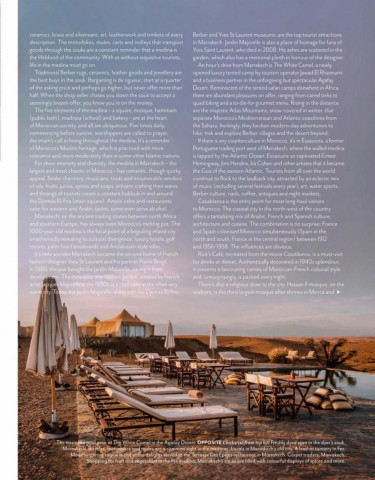
                          The oasis-like pool area at The White Camel in the Agafay Desert. OPPOSITE Clockwise from top left Freshly dyed yarn in the dyer’s souk,
                             Marrakech. Bicycles, motorbikes and mules are a common sight in the medinas. Locals in Marrakech’s old city. A leather tannery in Fes.
                                Mouthwatering tagine is one of the delights served at the Terrasse Des Épices restaurant in Marrakech. Carpet traders, Marrakech.
                                       Shopping for fruit and vegetables in the Fes medina. Marrakech’s souks are filled with colourful displays of spices and more.

