


Page 68 - Australian House & Garden (January 2020)
P. 68
H G  INSIDER


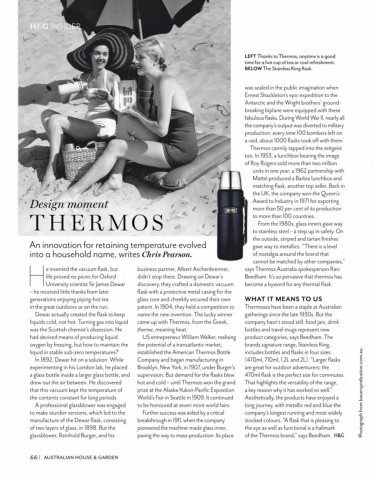
                                                                                                              LEFT Thanks to Thermos, anytime is a good
                                                                                                              time for a hot cup of tea or cool refreshment.
                                                                                                              BELOW The Stainless King flask.


                                                                                                              was sealed in the public imagination when
                                                                                                              Ernest Shackleton’s epic expedition to the
                                                                                                              Antarctic and the Wright brothers’ ground-
                                                                                                              breaking biplane were equipped with these
                                                                                                              fabulous flasks. During World War II, nearly all
                                                                                                              the company’s output was diverted to military
                                                                                                              production: every time 100 bombers left on
                                                                                                              a raid, about 1000 flasks took off with them.
                                                                                                                Thermos cannily tapped into the zeitgeist
                                                                                                              too. In 1953, a lunchbox bearing the image
                                                                                                              of Roy Rogers sold more than two million
                                                                                                                 units in one year; a 1962 partnership with

                                                                                                                 Mattel produced a Barbie lunchbox and
                                                                                                                 matching flask, another top seller. Back in
                                                                                                                 the UK, the company won the Queen’s
              Design moment                                                                                      Award to Industry in 1971 for exporting
                                                                                                                 more than 50 per cent of its production
              THER MOS                                                                                           to more than 100 countries.
                                                                                                                   From the 1980s, glass inners gave way
                                                                                                                 to stainless steel – a step up in safety. On
                                                                                                                 the outside, striped and tartan finishes
              An innovation for retaining temperature evolved                                                    gave way to metallics. “There is a level

              into a household name, writes Chris Pearson.                                                       of nostalgia around the brand that
                                                                                                                 cannot be matched by other companies,”
                     e invented the vacuum flask, but          business partner, Albert Aschenbrenner,         says Thermos Australia spokesperson Ravi
                     life proved no picnic for Oxford         didn’t stop there. Drawing on Dewar’s           Beedham. It’s so pervasive that thermos has
             HUniversity scientist Sir James Dewar            discovery, they crafted a domestic vacuum       become a byword for any thermal flask.
              – he received little thanks from later          flask with a protective metal casing for the
              generations enjoying piping-hot tea             glass core and cheekily secured their own       WHAT IT MEANS TO US
              in the great outdoors or on the run.            patent. In 1904, they held a competition to     Thermoses have been a staple at Australian
                Dewar actually created the flask to keep       name the new invention. The lucky winner        gatherings since the late 1930s. But the
              liquids cold, not hot. Turning gas into liquid   came up with Thermos, from the Greek,          company hasn’t stood still: food jars, drink
              was the Scottish chemist’s obsession. He        therme, meaning heat.                           bottles and travel mugs represent new

              had devised means of producing liquid             US entrepreneur William Walker, realising     product categories, says Beedham. The
              oxygen by freezing, but how to maintain the     the potential of a transatlantic market,        brands signature range, Stainless King,
              liquid in stable sub-zero temperatures?         established the American Thermos Bottle         includes bottles and flasks in four sizes
                In 1892, Dewar hit on a solution. While       Company and began manufacturing in              (470ml, 710ml, 1.2L and 2L). “Larger flasks
              experimenting in his London lab, he placed      Brooklyn, New York, in 1907, under Burger’s     are great for outdoor adventurers; the
              a glass bottle inside a larger glass bottle, and   supervision. But demand for the flasks blew   470ml flask is the perfect size for commutes.
              drew out the air between. He discovered         hot and cold – until Thermos won the grand      That highlights the versatility of the range,
              that this vacuum kept the temperature of        prize at the Alaska-Yukon-Pacific Exposition     a key reason why it has worked so well.”            Photograph from bauersyndication.com.au.
              the contents constant for long periods.         World’s Fair in Seattle in 1909. It continued   Aesthetically, the products have enjoyed a

                A professional glassblower was engaged        to be honoured at seven more world fairs.       long journey, with metallic red and blue the
              to make sturdier versions, which led to the       Further success was aided by a critical       company’s longest running and most widely
              manufacture of the Dewar flask, consisting       breakthrough in 1911, when the company          stocked colours. “A flask that is pleasing to
              of two layers of glass, in 1898. But the        pioneered the machine-made glass inner,         the eye as well as functional is a hallmark
              glassblower, Reinhold Burger, and his           paving the way to mass-production. Its place    of the Thermos brand,” says Beedham.  #


              66 |  AUSTRALIAN HOUSE & GARDEN

