


Page 109 - (DK Eyewitness) Travel Guide - Estonia Latvia & Lithuania
P. 109
EST ONIA REGION B Y REGION 107
EASTERN ESTONIA
The landscape of Eastern Estonia, punctuated with rolling hills,
lush forests, limestone escarpments and pristine lakes, is more
diverse than the country’s western part. This truly fascinating
region combines idyllic scenery with picturesque old manor
houses and the unique cultural heritage of the Setu people
and Old Believers, which have survived through the centuries.
Despite its stunning landscape, some parts country’s nature reserves for the variety of
of Eastern Estonia are less frequented by its landscape and natural features. Further
tourists, especially the far northeast, along, the Ontika Coast, with its huge
southeast and around Lake Peipsi. The vast limestone escarpments and cas cading
mass of Lake Peipsi dom inates the central waterfalls, is breathtaking.
part of this region. The western shores of Sights of political, historic and social
the lake are dotted with the sizeable settle- history abound in the southeast as a
ments of Russian Old Believers who have whole. Viljandi is famous for its Folk Music
been living here for countless generations. Festival, while Estonia’s national flag was
Captured and conquered repeatedly by sanctified in Otepää, the winter sports
Russians from 1558 until Estonia’s capital, where snowboarding and ice
independence in 1991, the historic fortress skating bring the town to life. Tartu,
city of Narva still bears testimony to the Estonia’s second-largest city and its
enormous role Russia has played in spiritual and intellectual capital, is
shaping Estonia’s history. During World home to the nation’s oldest university.
War II, the value of oil-shale mining rose With attractions such as the grand
significantly, bringing Kohtla-Järve into Sangaste Manor and the captivating Suur
sharp focus. Today, this heavily industrial Munamägi viewing tower at the country’s
town serves as a vast, sprawling living highest point, the south and southeast are
monument to Soviet-era industry. among Estonia’s most scenic areas. In the
East of Tallinn, Lahemaa National Park far south east, the ethnographically distinct
is arguably the most beautiful of the Setu people continue to live traditionally.
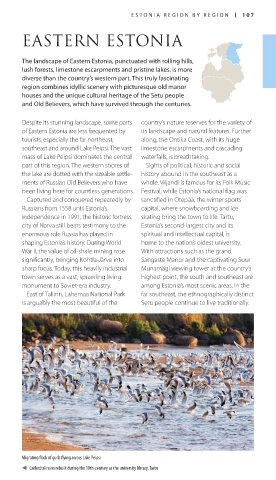
Migrating flock of gulls flying across Lake Peipsi
Cathedral ruins rebuilt during the 19th-century as the university library, Tartu
BT_106-107_RItroWEst.indd 107 25/02/2015 13:39

