


Page 178 - (DK Eyewitness) Travel Guide - Estonia Latvia & Lithuania
P. 178
176 LA T VIA REGION B Y REGION
ships in the late 19th and
early 20th centuries, fish
canning and the local Banga
fishermen’s collective.
E Sea-Fishing Museum
Selgas iela 33. Tel 6326 9594. Open
Jun–Sep: 10am–6pm Tue–Sun; Oct–
May: 10am–5pm Tue–Sat. & 8
e Dundaga
Road Map C3. * 4,000. @
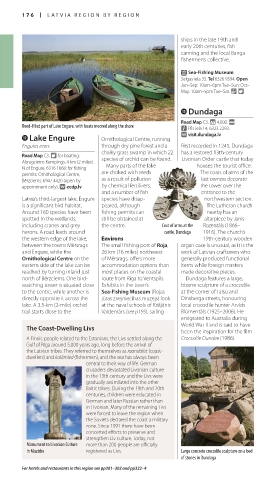
Reed-filled part of Lake Engure, with boats moored along the shore n Pils iela 14, 6323 2293.
w Lake Engure Ornithological Centre, running ∑ visit.dundaga.lv
Engures ezers through dry pine forest and a First recorded in 1245, Dundaga
chalky grass swamp in which 22 has a restored 13th-century
Road Map C3. 8 for boating:
Abragciems Kempings, 4 km (2 miles) species of orchid can be found. Livonian Order castle that today
N of Engure, 6316 1668; for fishing Many parts of the lake houses the tourist office.
permits: Ornithological Centre, are choked with reeds The coats of arms of the
Bērzciems, 6947 4420 (open by as a result of pollution last owners decorate
appointment only). ∑ eedp.lv by chemical fertilizers, the tower over the
and a number of fish entrance to the
Latvia’s third-largest lake, Engure species have disap- northwestern section.
is a significant bird habitat. peared, although The Lutheran church
Around 160 species have been fishing permits can nearby has an
spotted in the wetlands, still be obtained at altar piece by Janis
including cranes and grey the centre. Coat of arms at the Rozentāls (1866–
herons. A road leads around castle, Dundaga 1916). The church’s
the western edge of the lake, Environs 19th-century wooden
between the towns Mērsrags The small fishing port of Roja, organ case is unusual, as it is the
and Engure, while the 26 km (16 miles) northwest work of Latvian craftsmen who
Ornithological Centre on the of Mērsrags, offers more generally produced functional
eastern side of the lake can be accommodation options than items while foreign masters
reached by turning inland just most places on the coastal made decorative pieces.
north of Bērzciems. One bird- route from Rīga to Ventspils. Dundaga features a large,
watching tower is situated close Exhibits in the town’s bizarre sculpture of a crocodile
to the centre, while another is Sea-Fishing Museum (Rojas at the corner of Talsu and
directly oppo site it across the jūras zvejniecības muzejs) look Dinsberga streets, honouring
lake. A 3.5-km (2-mile) orchid at the naval schools of Krišjānis local crocodile hunter Arvīds
trail starts close to the Valdemārs (see p195), sailing Blūmentāls (1925–2006). He
emigrated to Australia during
World War II and is said to have
The Coast-Dwelling Livs
been the inspiration for the film
A Finnic people related to the Estonians, the Livs settled along the Crocodile Dundee (1986).
Gulf of Rīga around 5,000 years ago, long before the arrival of
the Latvian tribes. They referred to themselves as raandalist (coast-
dwellers) and kalāmīed (fishermen), and the sea has always been
central to their way of life. German
crusaders devastated Livonian culture
in the 13th century and the Livs were
gradually assimi lated into the other
Baltic tribes. During the 19th and 20th
centuries, children were educated in
German and later Russian rather than
in Livonian. Many of the remaining Livs
were forced to leave the region when
the Soviets declared the coast a military
zone. Since 1991 there have been
concerted efforts to preserve and
strengthen Liv culture. Today, not
Monument to Livonian Culture more than 200 people are officially
in Mazirbe registered as Livs. Large concrete crocodile sculpture on a bed
of stones in Dundaga
For hotels and restaurants in this region see pp301–302 and pp322–4
176-177_CapeNPT.indd 176 15/02/17 10:15 am

