


Page 202 - (DK Eyewitness) Travel Guide - Estonia Latvia & Lithuania
P. 202
200 LA T VIA REGION B Y REGION
t Daugavpils u Synagogue
Cietokšņa 42. Tel 6542 0092.
The second-most populous city in Latvia, Daugavpils is often Open by appointment.
regarded as a “Russian city” as the majority of its residents are Prior to World War I, over half
Russian. Its history can be traced to 1275 and a Livonian Order of the town’s population was
castle called Dinaburga. In the 16th century, a settlement Jewish. There were at one time
48 synagogues, of which only
grew on the banks of the Daugava river, and was occupied by one remains in use. It was
Poles, Russians and Swedes at various times. When the town renovated in 2006 with the
was developed into a Tsarist fortress in the early 19th century, help of Mark Rothko’s children,
civilians were relocated southeast to the land that today who had visited it in 2003, the
forms the city centre. An industrial hub for the erstwhile cen tenary of their father’s birth.
Soviet Union, Daugavpils has suffered from economic neglect R Cathedral of Sts Boris
since independence, though the city’s image is improving. and Glebe
Tautas iela 2. Tel 6545 3544.
This blue-and-white building,
resplendent with its ten golden
cupolas, is the largest Russian
Orthodox cathedral in the
country. Built in 1905, it is
named after the two saints on
whose feast day the Russian
army entered Daugavpils in
1656. The Russian name for the
town, Borisoglebsk, was also
taken from the saints’ names.
The icons and frescoes inside
were copied from those in
Sophia Cathedral in Kiev, Russia.
R Church of the Birth of
the Mother of God
Puškina 16a. Open services only. ^
A solid pink structure with
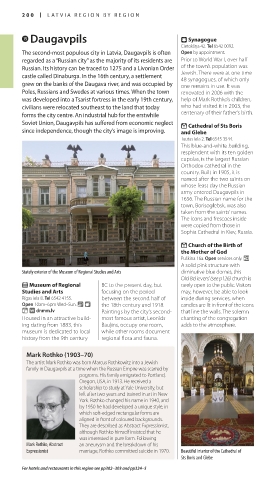
Stately exterior of the Museum of Regional Studies and Arts diminutive blue domes, this
Old Believers’ (see p126) church is
E Museum of Regional BC to the present day, but rarely open to the public. Visitors
Studies and Arts focusing on the period may, however, be able to look
Rīgas iela 8. Tel 6542 4155. between the second half of inside during services, when
Open 10am–6pm Wed–Sun. & 8 the 18th century and 1918. candles are lit in front of the icons
= ∑ dnmm.lv Paintings by the city’s second- that line the walls. The solemn
Housed in an attractive build- most famous artist, Leonīds chanting of the congregation
ing dating from 1883, this Bauļins, occupy one room, adds to the atmosphere.
museum is dedicated to local while other rooms document
history from the 9th century regional flora and fauna.
Mark Rothko (1903–70)
The artist Mark Rothko was born Marcus Rothkowitz into a Jewish
family in Daugavpils at a time when the Russian Empire was scarred by
pogroms. His family emigrated to Portland,
Oregon, USA, in 1913. He received a
scholarship to study at Yale University, but
left after two years and trained in art in New
York. Rothko changed his name in 1940, and
by 1950 he had developed a unique style, in
which soft-edged rectangular forms are
aligned in front of coloured back grounds.
They are described as Abstract Expressionist,
although Rothko himself insisted that he
was interested in pure form. Following
Mark Rothko, Abstract an aneurysm and the breakdown of his
Expressionist marriage, Rothko committed suicide in 1970. Beautiful interior of the Cathedral of
Sts Boris and Glebe
For hotels and restaurants in this region see pp302–303 and pp324–5
200-201_Duga.indd 200 15/02/17 10:20 am

