


Page 233 - (DK Eyewitness) Travel Guide - Estonia Latvia & Lithuania
P. 233
VILNIUS 231
prolific craftsman who carved
hundreds of shrines for rural
farmsteads and villages in the
Kėdainiai and Kaunas regions
(see pp262–5).
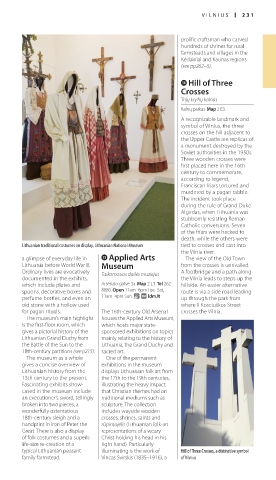
r Hill of Three
Crosses
Trijų kryžių kalnas
Kalnų parkas. Map 2 E3.
A recognizable landmark and
symbol of Vilnius, the three
crosses on the hill adjacent to
the Upper Castle are replicas of
a monument destroyed by the
Soviet authorities in the 1950s.
Three wooden crosses were
first placed here in the 16th
century to commemo rate,
according to legend,
Franciscan friars tortured and
murdered by a pagan rabble.
The incident took place
dur ing the rule of Grand Duke
Algirdas, when Lithuania was
stubbornly resisting Roman
Catholic conversions. Seven
of the friars were hacked to
death, while the others were
Lithuanian traditional costumes on display, Lithuanian National Museum tied to crosses and cast into
the Vilnia river.
a glimpse of everyday life in e Applied Arts The view of the Old Town
Lithuania before World War II. Museum from the crosses is unrivalled.
Ordinary lives are evocatively Taikomosios dailės muziejus A footbridge and a path along
documented in the exhibits, the Vilnia leads to steps up the
which include plates and Arsenalo gatvė 3a. Map 2 E3. Tel 262 hillside. An easier alterna tive
spoons, decorative boxes and 8080. Open 11am–6pm Tue–Sat, route is via a side road leading
perfume bottles, and even an 11am–4pm Sun. & ∑ ldm.lt up through the park from
old stone with a hollow used where T Kosciuškos Street
for pagan rituals. The 16th-century Old Arsenal crosses the Vilnia.
The museum’s main highlight houses the Applied Arts Museum,
is the first-floor room, which which hosts major state-
gives a pictorial history of the sponsored exhibitions on topics
Lithuanian Grand Duchy from mainly relating to the history of
the Battle of the Sun to the Lithuania, the Grand Duchy and
18th-century partitions (see p215). sacred art.
The museum as a whole One of the permanent
gives a concise overview of exhibitions in the museum
Lithuanian history from the displays Lithuanian folk art from
13th century to the present. the 17th to the 19th centuries,
Fascinating exhibits show - illustrating the heavy impact
cased in the museum include that Christian themes had on
an executioner’s sword, tell ingly traditional mediums such as
broken into two pieces, a sculpture. The collection
wonderfully ostentatious includes way side wooden
18th-century sleigh and a crosses, shrines, saints and
handprint in iron of Peter the rūpintojėlis (Lithuanian folk-art
Great. There is also a display represen tations of a weary
of folk costumes and a superb Christ hold ing his head in his
life-size re-creation of a right hand). Particularly
typical Lithuanian peasant illuminat ing is the work of Hill of Three Crosses, a distinctive symbol
family farmstead. Vincas Svirskis (1835–1916), a of Vilnius
230-231.indd 231 15/02/17 10:15 am

