


Page 255 - (DK Eyewitness) Travel Guide - Estonia Latvia & Lithuania
P. 255
LITHU ANIA REGION B Y REGION 253
CENTRAL LITHUANIA
Rolling hills, swathes of untouched ancient forest and
thousands of clear lakes characterize Central Lithuania.
Much of the land is protected, allowing birds, animals and
plants to thrive. While Vilnius and Kaunas are the region’s
most vibrant cities, the less-visited towns and villages of the
region, with their beautiful churches and farmsteads, also
attract a number of visitors.
Lithuania’s heartland is symbolized by berries line the roads, particularly
the mysterious mounds and fort-hills of along the route from Vilnius to the spa
Kernavė, where Mindaugas, the first king town of Druskininkai. Some parts of
of Lithuania, is said to have united the Dzūkija, which stretches from Alytus in
Baltic tribes in an effort to hold back the the west to Vilnius in the east, have large
cru sading armies of the Teutonic Knights. Polish-speaking communities. Aukštaitija,
Similarly, Trakai, with its fairytale Island which literally means “the highlands”,
Castle that once stood as the kernel of consists of relatively high ground that is
one of Europe’s biggest empires, stirs dotted with lakes. Although some forest
romantic nation alism in Lithuanians. has survived the centuries, much of
Kaunas, which served as the capital of Aukštaitija was used for agriculture
independent Lithuania between the two during the 20th century. With the
world wars, is often seen as the original exception of the Russian-speaking
seat of its nationhood, rather than town of Visaginas, Aukštaitija is
Vilnius, the present-day capital. almost exclusively Lithuanian-
Three of the country’s four speaking and is the country’s archaic
ethnographic regions, each with its hinterland. Centred around Marijampolė,
own dialect and traditions, are located Suvalkija, or Sūduva, is the smallest
in this area. Much of Dzūkija, in the ethnographic region, with its dress and
south, is thickly forested. In summer and customs once influenced by Prussia as
autumn, villagers selling mushrooms or well as Poland.
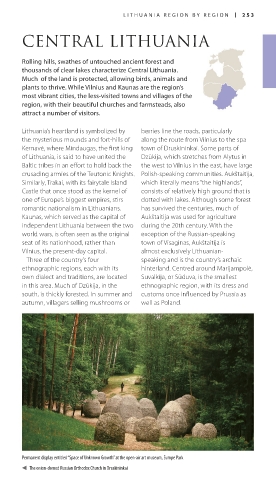
Permanent display entitled “Space of Unknown Growth” at the open-air art museum, Europe Park
The onion-domed Russian Orthodox Church in Druskininkai
BT_252-253_centLit.indd 253 25/02/2015 13:32

