


Page 314 - (DK Eyewitness) Travel Guide - Estonia Latvia & Lithuania
P. 314
312       TRA VELLERS ’  NEEDS


       What to Drink
       Beer is popular in the Baltic States and several of the region’s
       breweries date back to the 19th century. Vodka is not as
       popular as it was during the Soviet era, although it is still
       widely drunk and both local and Russian brands are available.
       The region also has some unusual spirits and liqueurs made
       with herbs. Although wine-drinking does not have a
       distinguished history, imported wine is available in
       restau rants and many affordable local sparkling wines are
       available. The most prominent traditional soft drink, kali in
                                                  Rīga Black   Bobelinė,
       Estonia, kvass in Latvia or gira in Lithuania, has been claimed
                                                 Balsam, Latvia  Lithuania
       as a forerunner of strong beer. Customarily made from rye
       bread and very mildly alcoholic, it is a refreshing alternative    blackcurrant juice or vodka.
       to aerated drinks such as cola.         Specialist shops, and some
                                               bars, also sell Latvian liqueurs
                                               such as the caraway-flavoured
       Wines
                           stopped during the Soviet   Allažu Ķimelis.
       Although the Baltic States are   occupation. It has been     Lithuania has a range of
       not a major wine-producing   restarted but is very limited and   herbal liqueurs, including Trejos
       region, both Latvia and   often the only chance to try the   Devynerios. Concocted by a
       Lithuania produce sparkling   wine is by attending the annual   pharmacist in the late 19th
       wines, such as Rīga   wine festival in summer.  century, Trejos Devynerios was
       Šampanietis and Alita                   listed as a legal patent medicine
       Šampanas respectively. In               bet ween the two world wars.
       Estonia, mulled red wine,   Spirits and Liqueurs  Vodka drinkers may want to try
       known as hõõgvein or glögg, is   The best-known Estonian   Starka, which is distilled from
       popular in winter. Served   liqueur is the sweet-tasting   rye grain, while other traditional
       warm, it has a spicy taste due   Vana Tallinn, which has   drinks are honey-based mead
       to the cinnamon and cloves   ingredients such as citrus oils,   and bobelinė, a liqueur made
       used to flavour it. Fruit wines,   cinnamon, vanilla and rum. It   with cranberry juice. In rural
       such as Põltsamaa Kuldne,   can be drunk neat but is   areas throughout the
       which is made from apples, are   worth trying in coffee or   region, local people brew
       also common.        over ice cream. It is also   their own, very potent,
         Latvia appears in the Guinness   used to make cocktails or   vodka. Visitors should be
       Book of World Records for the   mixed with white wine or   wary of this, as it is
       northermost open-air vineyard   champagne. Vodka is also   usually of low quality and
       in the world. Sabile Wine Hill   popular in Estonia, and   there have been cases
       vineyard (Sabiles, Vīna Kalns)   Viru Valge is the most   where batches have
       (see p182), has a long history of   common local brand. In   Vana Tallinn   been contaminated
       viniculture, but production   addition to the original   liqueur  with methanol. In
                              version, it is available   Lithuania, a legitimate
                              in flavoured varieties    drink takes the name of this
                              such as vanilla, lemon    illegal vodka, Samanė, but is not
                              and watermelon.  as strong.
                              For visitors to Latvia, Rīga
                              Black Balsam is an
                               unmissable drink and   Beer
                                makes a popular   After independence in 1991, the
                                souvenir, although   region’s state breweries were
                                perhaps as much for   privatized and many of them
                                its ceramic bottle as   were subsequently bought by
                                for the liquid inside.   large international corporations.
                                Developed in 1752 as   Baltic Beverages Holdings,
                                a medicinal tonic,    jointly owned by Carlsberg and
                                it is composed of a   Scottish & Newcastle, owns
                                top-secret list of   several of the region’s biggest
                                ingredients and is an   brands, such as Saku in Estonia,
                                acquired taste.   Aldaris in Latvia and Utenos and
                                Occasionally drunk   Švyturys in Lithuania. The
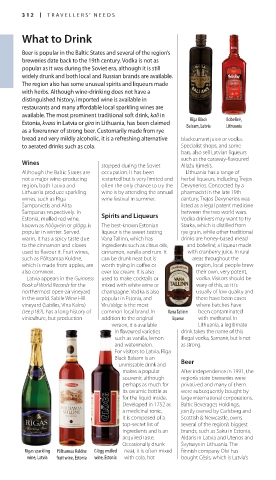
       Rīgas sparkling   Põltsamaa Kuldne   Glögg mulled   neat, it is often mixed   Finnish company Olvi has
        wine, Latvia  fruit wine, Estonia  wine, Estonia  with cola, hot   bought Cēsis, which is Latvia’s

