


Page 68 - (DK Eyewitness) Travel Guide - Estonia Latvia & Lithuania
P. 68
66       EST ONIA  REGION  B Y  REGION


                           The display, which includes rare   programmes. The papers and
                           daguerreotypes, ambrotypes   instruments of the eminent
                           and ferrotypes, showcases    Estonian composer Peeter Süda
                           some of the finest works by   (1883–1920) form a small part
                           well-known early Estonian   of the museum’s collection.
                           photographers, including    The staff are happy to play the
                           H Tiidermann, B Lais and    instru ments for a small fee. The
                           N Nyländer. Pride of place is   museum owns the copyright
                           given to the tiny Minox camera   to the work of composer
                           which was reputedly invented   Heino Eller (1887–1970)
                           in Estonia in 1936. The gallery   and since 1998, it has been
                           also hosts temporary exhibitions   awarding the prestigious
                           of contemporary works.  Heino Eller Music Prize to
                                               distinguished figures.
       An 1898 photograph, Museum of
       Estonian Photography  6 Niguliste Church
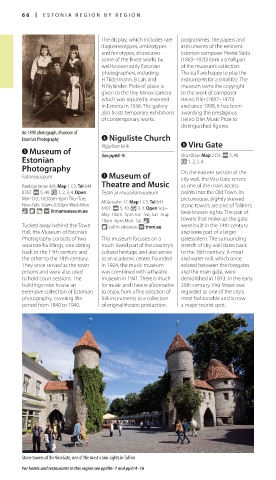
                           Niguliste kirik     8 Viru Gate
       5 Museum of
                           See pp68–9.         Viru tänav. Map 2 D3. @ 5, 40.
       Estonian                                v 1, 2, 3, 4.
       Photography                             On the eastern section of the
       Fotomuuseum         7 Museum of         city wall, the Viru Gate serves
       Raekoja tänav 4/6. Map 1 C3. Tel 644   Theatre and Music    as one of the main access
       8767. @ 5, 40. v 1, 2, 3, 4. Open   Teatri-ja muusikamuuseum  points into the Old Town. Its
       Mar–Oct: 10:30am–6pm Thu–Tue;   Müürivahe 12. Map 1 C3. Tel 644   picturesque, slightly skewed
       Nov–Feb: 10am–5:30pm Wed–Mon.   6407. @ 5, 40. v 3, 4. Open Sep–  stone towers are one of Tallinn’s
       & 8 = ∑ linnamuuseum.ee                 best-known sights. The pair of
                           May: 10am–5pm Tue–Sat; Jun–Aug:
                           10am–6pm Mon–Sat. &    towers that make up the gate
       Tucked away behind the Town   8 call in advance. ∑ tmm.ee  were built in the 14th century
       Hall, the Museum of Estonian            and were part of a larger
       Photography consists of two   This museum focuses on a    gatesystem. The surrounding
       separate buildings, one dating   much-loved part of the country’s   stretch of city wall dates back
       back to the 14th century and   cultural heritage, and also serves   to the 16th century. A moat
       the other to the 18th cen tury.   as an acade mic centre. Founded   and water mill, which once
       They once served as the town   in 1924, the music museum    existed between the foregates
       prisons and were also used    was com bined with a theatre   and the main gate, were
       to hold court sessions. The   museum in 1941. There is much   demolished in 1843. In the early
       buildings now house an   for music and theatre aficionados   20th century, Viru Street was
       extensive collection of Estonian   to enjoy, from a fine selection of   regarded as one of the city’s
       photography, cover ing the   folk instruments to a col lection    most fashionable and is now
       period from 1840 to 1940.    of original theatre production   a major tourist spot.


       Stone towers of the Viru Gate, one of the most iconic sights in Tallinn
       For hotels and restaurants in this region see pp296–7 and pp314–16

